🙄just ban all cobbled classics and go to dubai instead
omloop with 50 riders at the start would still be far more dangerous than riding on highways in the desert
🙄just ban all cobbled classics and go to dubai instead
omloop with 50 riders at the start would still be far more dangerous than riding on highways in the desert
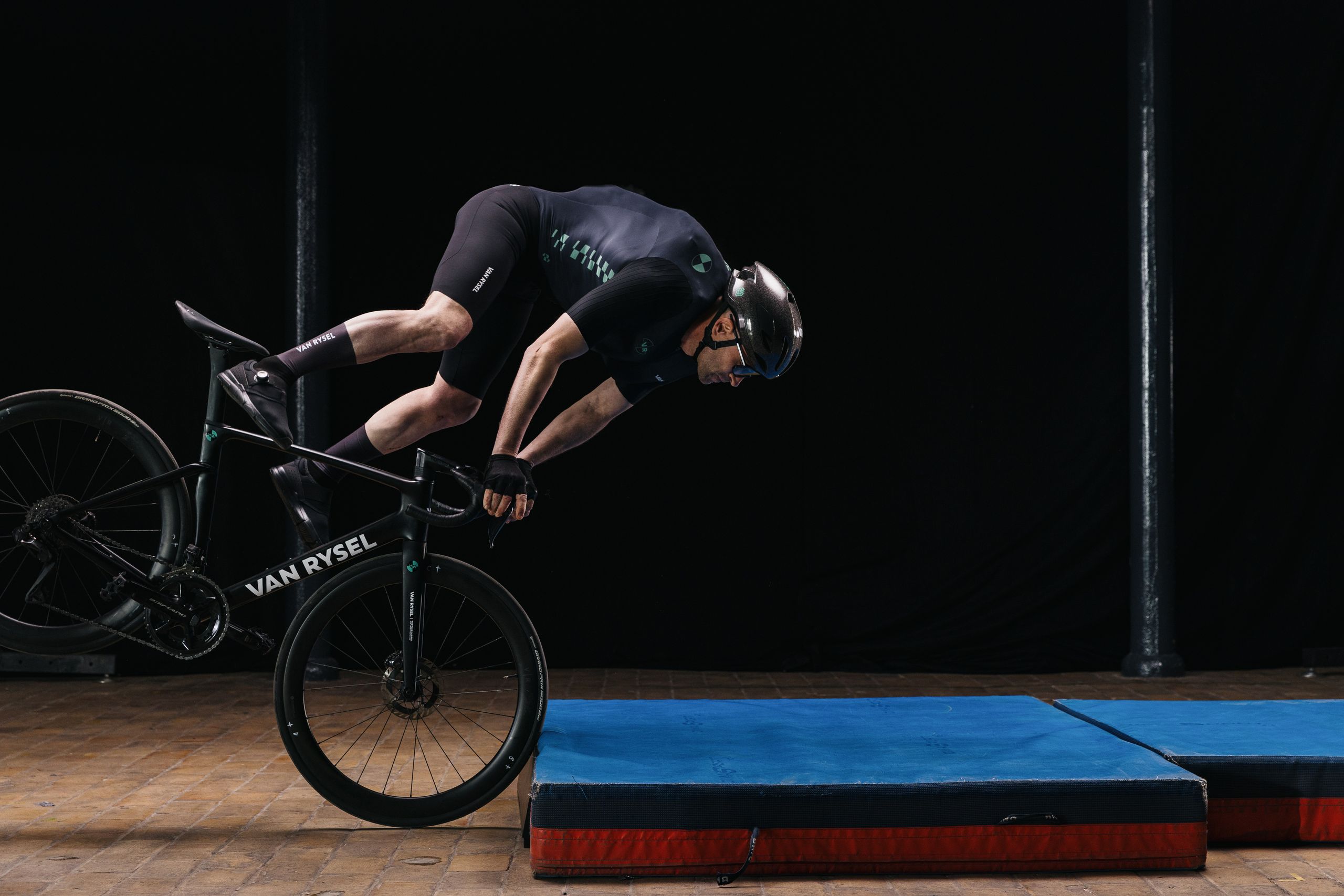
Airbags seem to be a good idea, but which one of these injuries would have been prevented if the riders had worn them?If you read the injury shopping list.... riders with broken teeth, collarbones, pelvis, Kung injury described so far as a fracture to thigh area?
Training crashes have nothing to do with the solutions to pro racing crashes. Open roads alone or in small groups has a totally different risk profile to a full péloton at race speeds on closed roads. Oftentimes the very same things that can make a road entirely unsuitable for race conditions are essential safety features of that same road when open to traffic.
Conflating the two just detracts from your point.
As for the sport getting banned due to danger levels, the Isle of Man TT still takes place every single year.
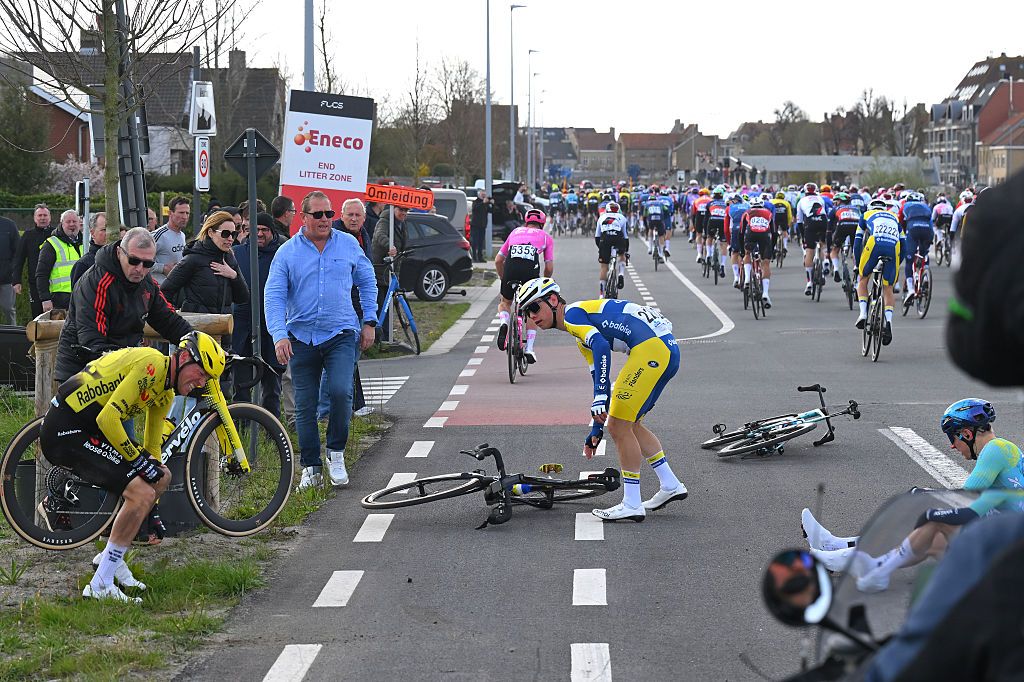
Airbags seem to be a good idea, but which one of these injuries would have been prevented if the riders had worn them?
And which crashes were caused by reckless riding? The only "dumb/avoidable" crashes I saw were caused by riders trying to put on or remove their raincoats. And the consequences seemed relatively minor.
So, what can be done, really?
There are more crashes than before. Probably the strongest correlate is increased speed but it all hangs together with evrything else. The race is "on" for much longer than before now. Which increases speed in turn. DS are rightly panicking about being at the front because the cost of being at the back is very high with the large peloton (also due to the risk of crashes).I've been saying this for a while, the biggest problem is this obsession from DS's to be at the front. I turn on KBK and the riders are fighting tooth and nail to get to some random right hand bend with over 100k to go.
However, I don't think there's much more crashes than before, I remember the opening stages of the 2010 Giro in Holland being a crash fest, 2004/11/15/21 TDF first weeks had loads of big crashes, and the 2007 GW was the worst day of crashes I have ever seen.
broken teeth? collarbones? pelvis? thigh? The only workable prototype of a cycling airbag we have seen would have done nothing to help.Likely most.
broken teeth? collarbones? pelvis? thigh? The only workable prototype of a cycling airbag we have seen would have done nothing to help.
But anyway, it would at least be a step in the right direction. Better than nothing.
But not enough.
Did you even read the articles you were citing? The Zoe Backstedt one was about a training crash.I don't know to whom you replied with this as at least last couple of posts didn't involve training crashes. As for possible introduction of more safety apparel in pro road peloton, that IMHO will affect training sessions too. Luckily.
Motor racing is pretty mainstream, although the TT is pretty niche within it. And of course the pro road péloton doesn't want to be associated with it in terms of athlete safety. And, you know what, it isn't. Because it's a lot safer - even in its current state - than the TT is. And yet the TT runs every year and it is not under threat of being banned altogether.Is Isle of Man TT a mainstream sport and/or where there ever calls involved to ban it altogether? Do you reckon does pro road peloton want to be associated with it in terms of athlete safety?
I disagree. There have always been crashes, but there are considerably more now.I've been saying this for a while, the biggest problem is this obsession from DS's to be at the front. I turn on KBK and the riders are fighting tooth and nail to get to some random right hand bend with over 100k to go.
However, I don't think there's much more crashes than before, I remember the opening stages of the 2010 Giro in Holland being a crash fest, 2004/11/15/21 TDF first weeks had loads of big crashes, and the 2007 GW was the worst day of crashes I have ever seen.
Maybe help for a collarbone; the easiest injury to heal. They can help shield the vital organs from the one organ that makes the mistakes. The helmet is supposed to protect that.broken teeth? collarbones? pelvis? thigh? The only workable prototype of a cycling airbag we have seen would have done nothing to help.
But anyway, it would at least be a step in the right direction. Better than nothing.
But not enough.
Did you even read the articles you were citing? The Zoe Backstedt one was about a training crash.
Motor racing is pretty mainstream, although the TT is pretty niche within it. And of course the pro road péloton doesn't want to be associated with it in terms of athlete safety. And, you know what, it isn't. Because it's a lot safer - even in its current state - than the TT is. And yet the TT runs every year and it is not under threat of being banned altogether.
And nor is professional road cycling, except in your most hare-brained hyperbole.
www.cyclingnews.com
www.cyclingnews.com
Yes it does, because, as I mentioned, training is entirely different from racing, and road furniture that is a danger for road racing is an essential safety feature the rest of the year. When you're debating the dangers of road racing, crashes outside of race conditions are entirely irrelevant.That explains it as the reaction was implying you were triggered by something but i didn't know what caused it. Well, the truth is it doesn't make much difference, does it?
There is a huge, huge, insane logical leap of interpretation from "more riders have got injured early season than usual" to "people are legitimately calling for this sport to be banned".I don't know about that, the era of naivety is IMHO over, more in depth coverage, pressure and sensitivity on the raise:
![]()
Over 40 riders on the sidelines after spate of early-season crashes – Pro cycling injury list 2026
WorldTour, Women's WorldTour and ProTeam riders sidelined from racing while recovering from injurieswww.cyclingnews.com
That has absolutely nothing to do with crashes in road racing or implementing of airbags. It's literally nothing to do with the point at hand. It is a perfectly reasonable discussion point, but it's completely unrelated to your prior argument or in fact this thread as a whole.On top of that i guess that is only the tip of the iceberg:
![]()
'I felt an obligation to be truthful and speak out' – Why Demi Vollering wants to keep periods and women's health in the spotlight in cycling
Former Tour de France Femmes champion has habitually spoken about periods, nutrition and health, saying 'it's very important to keep speaking up'www.cyclingnews.com
It's a well known fact that if a woman keeps body fat percentage too low for prolonged time certain biological processes simply stop and illness such as osteoporosis surges. In modern sport such things are becoming a part of the sport, on where in the past the sport wanted to keep it out. Cycling here i guess again not on the frontiers but again likely one of the last sport to acknowledge it.
Yes it does, because, as I mentioned, training is entirely different from racing, and road furniture that is a danger for road racing is an essential safety feature the rest of the year. When you're debating the dangers of road racing, crashes outside of race conditions are entirely irrelevant.
Bicycle helmets are a utter engineering joke as I have repeated dozens of different ways. Your head doesn't know if you are falling on pavement at 50mph from a motorcycle or bicycle but bicycle industry insists that somewhere forces nobody can see or describe determine a different outcome in injury and protection.
Many water ski helmets have better engineering and protective properties.
Polo, skateboards, snow skiing, rock climbing, many are generally better than bike helmet design which have only grown more to look like ridiculous polystyrene toupees with some protection on top, none on rear held or by a strap resembling a healthy shoelace.
And as I have repeated, there is no data, none.
"Maybe I wouldn't be here today if I hadn't had a helmet on"
There is a huge, huge, insane logical leap of interpretation from "more riders have got injured early season than usual" to "people are legitimately calling for this sport to be banned".
That has absolutely nothing to do with crashes in road racing or implementing of airbags. It's literally nothing to do with the point at hand. It is a perfectly reasonable discussion point, but it's completely unrelated to your prior argument or in fact this thread as a whole.
You detract from any good points you have to make when your argument is presented in ludicrously bad faith.
You supported the point of there being too much danger in racing by including an article about someone who crashed in training. Then you claimed you didn't post an article about a crash in training. When then confronted with the evidence that, in fact, you did, you claim it still supports your point.
You claimed that cycling is on its way to being banned, a completely and utterly baseless statement, which you attempt to support by posting a link to an article that claims nothing more than "more riders than usual have got hurt so far this season", and then for some reason throw in a completely unrelated article about women's health that has absolutely nothing to do with the outcomes of crashes. Literally nothing is said in that article about rider safety in the context of crashes and injuries.
So, again, I ask you, do you actually read the articles you post in favour of your argument? Or do you just make your argument and throw hyperlinks in there in the blind hope that it supports your point?
You posted it in response to an article about the number of race crashes on opening weekend. I'm sorry, but an article about a training crash is not relevant to in-race crashes on opening weekend. Arguing that the importance of the helmet makes it relevant is completely disingenuous, when helmets have been compulsory at all times in pro cycling for 20 years, so every single rider involved in a crash during a race should be wearing a helmet.Of course that is not a valid claim at all and athlete safety is important on training sessions too. It even goes beyond that all the way down to amateur level and casual cyclists. Why was super tuck banned? It wasn't due to professional cyclists, it was due to not representing a bad example to copy for amateur cyclists. Testimonials of some prominent cycling personas or even regular amateurs are hence perfectly valid here.
![]()
"Maybe I wouldn't be here today if I hadn't had a helmet on": Zoe Bäckstedt on her scary crash, quick recovery, and Olympic goals
A severe training crash just two weeks before the start of the cyclocross season could have derailed Zoe Bäckstedt's entire winter. Instead, the 21-year-old Welsh cycling star made a remarkable recove...cyclinguptodate.com
You do realise this is actually a weakness in your argument, right? That the number of injuries might not be going up as much, it's just that reporting of those injuries is better now?It used to be rather hard to get stats of injuries but lately even popular cycling orientated news sites report them. Kudos to that. So you feel it's sustainable to have 40 riders out in early March due to the injuries with gazillion more lucky enough to only crash?
You're tilting at windmills, Abi. You're inventing a situation in your head, imagining the worst possible outcome to it, and screaming that everybody needs to believe in your invented apocalyptic scenario. There have been a high number of injuries in the early season this year that mean that the people in charge of the sport need to consider whether any action can or should be taken. Nothing more, nothing less. It doesn't present a danger to the existence of professional cycling any more than a few high-profile players getting their legs broken presents a danger to the existence of professional soccer.This is something that won't start to represent a real issue to pro road peloton, maybe even existential one? At least in terms of positioning it as a mainstream sport.
Why wouldn't it?
But the article has nothing to do with crashes, and has absolutely nothing to do with apparel. It's completely off-topic for this thread. You could put it in the general women's cycling thread, you could put it in the Demi Vollering thread, you could make a new thread to discuss it.I expected some backlash on this one and some of your concerns are valid but you have to understand that so far i haven't seen any discussion about it and one could i guess need some guidance on where to put a discussion on women periods.
The decision, on why i posted is here is:
So in short, by athletes getting better apparel and by that reducing the number of injuries and by setting some thresholds, as for example minimal percentage of body fat still allowed to enter a GT, by doing that we can substantially improve athlete health.
- It has to be discussed somewhere.
- It shouldn't be discussed in some obscure topic.
- We somehow determined that at least in near future nobody will do anything to prevent actual crashes.
- Ultimately mid term strategy will be to mitigate, that is to reduce injuries.
- Health is hence what we can do, the thing we can do about crashes.
- Health is what we can furthermore substantially improve, at least on the woman side, by settings such rules and conditions, for biological processes to be ongoing as normal.
As for somebody doing anything to actually reduce number of crashes. Who? It's riders fault anyway, isn't it? So all in all health it is then, beyond that forget it, to much reluctance involved for now.