


- Sep 20, 2017
- 13,275
- 24,835
- 28,180
A little bit of news on my end. Between me being worse than ever at keeping these posts to a normal length (as evidenced by the below), me not having had as much free time as I had expected the past few weeks, and me having spent a sizeable chunk of said free time watching snooker (sorry not sorry), I am unfortunately not going to be done in time to post a stage-by-stage analysis before the Giro starts. I will, however, be putting everything up as OPs to stage threads.
With that out of the way, on with the show.
After last year’s anomaly in Albania, RCS returns to its favourite kind of stage to have in a foreign Grande Partenza: a flat sprint.
Map and profile


Start
WARNING: a lot of talk about history, even by my standards.
For the Grande Partenza proper, RCS and the Bulgarian government have selected the town of Nessebar. At a population size of just over 13000 inhabitants, it may seem a surprising choice at first. However, it makes sense once you realise that it is located in the heart of Bulgaria’s most touristic region, a stone’s throw away from the resort town called Слънчев бряг in Bulgarian but well-known abroad by its English translation: Sunny Beach. I’m surprised that the race doesn’t so much as pass through it, but perhaps the Bulgarians wanted to show that their Black Sea coast is more than a destination for cheap beachside booze.
For that purpose, they couldn’t have picked a better spot than Nessebar. Its location just off the coast on an island (which has since been connected to the mainland by a causeway) made for a perfect combination of accessibility and defensibility, hence the site was settled very early (12th century BC or prior) by the Thracians, the region’s original inhabitants. The town, then known as Mesembria, grew significantly after the arrival of Greek colonists in the 6th century BC. Various Greek sources, including Aristotle, record Mesembria as being the birthplace of the famous fable writer Aesop, although his supposed birthdate (it is debatable whether an Aesop ever existed) predates colonisation.
In the late 6th century, the western Black Sea coast was occupied by the Persians, who retained control until they were forced out of Europe by the Greeks in the decades after the failure of the second Persian invasion of Greece in 489 BC. The Thracians now organised themselves into an organised state for the first time: the Odrysian kingdom, roughly overlapping with modern Bulgaria. Ties with Greece became increasingly close, and during the Peloponnesian War, the Odrysians wound up fighting on the side of Athens. Mesembria itself even became a member of the Athens-led Delian League.
The Peloponnesian War reshaped the wider Greek world, both because it broke the power of Athens and because the devastation permanently weakened large parts of Greece. Even in modern Bulgaria, which was peripheral to the conflict at most, the failure of the side it had been allied to had a major impact from the end of the war in 404 BC onwards. The Odrysian kingdom gradually disintegrated, and the territory was swept up by the Macedonians between 342 and 340 BC. After the death of Alexander the Great, a new power vacuum emerged, into which the invading Celts stepped. They would hold sway for most of the 3rd century BC, but the Thracians had regained the upper hand by the time the Romans entered the region in the next century, and would rule what is now Bulgaria as Roman client kings until annexation in 46 AD.
In the later Roman period, Mesembria grew in importance again, partly because the centre of power shifted closer to Thrace when Constantinople was established as the capital, partly because its defensible nature became more important as barbarian raids became more frequent. The first half of the Migration Period is by far the better known, as it led to the collapse of (the western half of) the Roman Empire. But while its effects on this region, too, cannot be understated, it is the second half where Bulgaria emerges as a distinct entity. In the late 6th and early 7th century, most of the Balkans were settled by the South Slavs, taking advantage of a Byzantine Empire occupied by its final and most devastating wars with Persia. In the 7th century, they were followed by the Bulgars, a Turkic people. The Bulgars had briefly held a large nomadic empire on the northern side of the Black Sea at the start of the century, but after its disintegration, some tribes migrated westward, reaching the Danube delta by the 670s. The Byzantines attempted to check this advance, but were defeated and forced to accept the establishment of the First Bulgarian Empire, which initially only partially coincided with modern-day Bulgaria as it was centred around the lower Danube. The areas further south, including Mesembria, remained Byzantine. The Bulgars dominated the new empire politically, but the population was majority Slavic, which explains why Bulgaria speaks a Slavic language today.
By this time, Arab power had reached its zenith, wiping Persia off the map and threatening to do the same with the Byzantine Empire. The Byzantines were embroiled in a series of civil wars at this time, one of which had seen the Bulgarians enlisted in a successful bid by a deposed emperor to reclaim his throne. The upshot of all this was a treaty in 716, which expanded Bulgarian territory further into modern-day Bulgaria (leaving Mesembria as the northernmost Byzantine outpost on the Black Sea), but also ended hostilities for the time being. This proved critical, as the Arabs besieged Constantinople for the second time the year after. Partially because of this agreement, partially because of successful Byzantine diplomacy, and partially because the Bulgarians were well aware that they were next in line if Constantinople were to fall, a Bulgarian army was dispatched to help break the siege. In conjunction with Byzantine naval superiority and a harsh winter, the Arabs were defeated. They would never come this close to capturing Constantinople again, and the Byzantine Empire would remain a shield behind which large parts of Europe could hide from Muslim expansion until the end of the Middle Ages.
Thus started a centuries-long cycle of alliances, wars and truces between the Bulgarians and the Byzantines. Most of the 8th century saw the latter regain the upper hand, but fail to land a decisive blow in spite of Bulgarian internal strife. By the end of the century, said instability had been ended under the rule of Kardam, who forced the Byzantines into a disadvantageous treaty in 792. Kardam was succeeded by Krum, who was so successful that his name remains in use as a given name in Bulgaria today (someone should have told J.K. Rowling that it’s not a surname, though). By the end of Krum’s reign in 814, he ruled what is now Romania, Moldova, the eastern half of Hungary and the northern half of Serbia (although control north of the Danube was much looser). In Bulgaria, he captured Serdica (modern-day Sofia) and massacred the Byzantine garrison in 809. The ensuing Byzantine counter-campaign succeeded in sacking the Bulgarian capital at Pliska in 811, but the army was forced to retreat and then successfully ambushed by Krum. The Byzantine emperor, Nicephorus I, was among the many who were killed. The Bulgarians were then able to capture Mesembria the year after, leaving Plovdiv and its surroundings as the only part of modern-day Bulgaria outside their control until this area, too, was captured in the 830s, alongside further expansion in the Balkans.
The First Bulgarian Empire was now near its zenith. Although the Byzantines were able to hold their own, even regaining control of Mesembria for a few decades, the Bulgarians were stronger militarily and experienced a period of economic and cultural prosperity by the standards of the age. The 9th century is notable for the invention of the Cyrillic script, and the conversion to Christianity under Boris I, but it is not until the reign of Simeon the Great between 893 and 927 that the Empire reached its true peak. While control north of the Danube seems to have definitively ended by this point, this was easily offset by major gains in the Balkans – by the end of Simeon’s reign, the borders extended as far west as Sarajevo and the Albanian coast. In addition, Bulgaria was now the most important centre of literature and religion in the Slavic world. Prosperity continued under Simeon’s son Peter I, but military success very much did not. In 966, the Byzantines allied with the Kyivan Rus’, and the latter overran modern-day Bulgaria, which was now reincorporated into the Byzantine Empire after the alliance with Kyiv turned sour. Although there was a revival in the surviving Balkan half of the First Bulgarian Empire, and control over much of the east was re-established for a while, this resurgence was only temporary. In 976, Basil II ascended to the Byzantine throne. His 49-year reign was to be the longest of any Roman or Byzantine emperor, and his epithet the Bulgar Slayer should tell you all you need to know about the fate of the First Bulgarian Empire.
Basil II is generally regarded as one of the best Byzantine emperors, but his death precipitated a long period of internal strife and misrule, culminating in the loss of virtually all of its Asian territories after what is often regarded as the most disastrous defeat in their history, Battle of Manzikert in 1071. While there was a final major resurgence from 1081 onwards under the Komnenian dynasty, the Byzantine Empire was permanently weakened in all aspects by this loss. When the so-called Komnenian Restoration came to an end with the death of Emperor Manuel I in 1180, the Byzantines proved unable to survive another bout of prolonged civil war. By the time this tailspin culminated in the Sack of Constantinople in 1204, the Bulgarians had already taken advantage of the situation to reestablish their independence. The Sack was greatly advantageous to them, as neither the Latin Empire established by the former Crusaders nor the surviving fragments of the Byzantine Empire were particularly strong, and if vassal states are included, the size of this Second Bulgarian Empire approached that of the First under Simeon in the first half of the 13th century.
However, this state, too, would not survive forever, and its decline started as early as the mid-13th century. To the south, the Byzantines regained control of Constantinople in 1261 and were somewhat resurgent, among others recapturing Mesembria in 1263. Even so, this final incarnation of the Byzantine Empire was a shell of its former self, and for both states, the real threat lay elsewhere. During this time, Bulgaria suffered from repeated invasions by both the Hungarians and the Mongol hordes, briefly becoming vassals of the latter at the end of the century. In 1300, Bulgarian authority was reasserted once more, with Mesembria retaken in this period of rebound, but by this point the balance of power had shifted so much that a Bulgarian-Byzantine alliance proved unable to contain Serbia. More importantly, the Ottomans were starting to rise in earnest. The Byzantines were the first of the two to come into conflict, but the already-disintegrating Second Bulgarian Empire would be the first to fall, at the close of the 14th century. Mesembria did not yet fall under Ottoman control, having been returned once more to the Byzantines by the Savoyard crusaders (who had been supposedly dispatched to fight the Ottomans, but wound up mostly attacking the Bulgarians) in 1366 and only being annexed in 1453.
The Ottoman period was neither kind to Mesembria nor to Bulgaria in general. In spite of Ottoman military and economic success reaching its zenith in the 16th and most of the 17th centuries, this time was characterised in Bulgaria by population decline (which had started during the slow unravelling of the Second Bulgarian Empire, was initially reversed after the Ottoman conquest, then resumed in the 17th century) and the forced integration of the Bulgarian Orthodox church into the Greek Orthodox equivalent. Mesembria itself had suffered from multiple sackings, and had been chained to the corpse of the Byzantine Empire while the Ottomans developed their own structures elsewhere along the coast. While there is still significant construction in the old town dating back to the Ottoman era, the town’s significance was clearly reduced by this point.
That allows me to turn to the latter half of Ottoman rule in Bulgaria. The long age of Ottoman expansion was definitively ended at the Battle of Vienna in 1683, and the remainder of the Ottoman Empire’s history is characterised by the weakening of the state and the gradual loss of territory. The loss of authority helped create the conditions for the rise of Bulgarian nationalism in the 19th century. The Bulgarian church seceded from the Greek – with the blessing of the sultan, but very much not that of the Patriarch – in 1870. However, this did not put an end to dissatisfaction, and things came to a head throughout the Balkans after the Ottomans increased taxes upon defaulting on their loans in 1875. Bulgaria was not the only place where this led to an uprising, and this particular April Uprising was neither large nor well-planned enough that it should have been more than a footnote in history. Indeed, the Ottomans were able to put it down fairly easily… but did so by massacring tens of thousands of civilians. These crimes against humanity were well-published in Britain, which had a long-standing alliance with the Ottoman Empire against the Russian Empire, in particular, and caused an outcry. As this was the late 19th century, the response was to gather the Great PowersTM at a conference, who demanded autonomy (under joint Ottoman-conference participant control) for both Bosnia and Herzegovina and Bulgaria (in typical fashion, North Macedonia was controversially lumped together with the latter). The Ottomans refused these demands, giving Russia a pretence to declare war once more. With Britain withholding support, the outcome was predictable. In fact, the Ottomans performed so poorly that they were pushed back to the outskirts of Constantinople, forcing Britain to deploy its navy to prevent a complete collapse. The trade-off was that the Ottomans agreed to worse terms than those they had previously rejected, and the newly-established Principality of Bulgaria (not including North Macedonia) was an Ottoman vassal in name only.
While many, not least the Russians themselves, had expected the new state to become a Russian vassal in practice, this was very much not the case. The new Bulgarian state was interested in territorial expansion, which caused tension with – among others – Russia’s ally Serbia, who also had plans to annex North Macedonia. Russia attempted to reverse this unwanted surprise with a coup d’etat in 1886, but this failed. Bulgaria remained underdeveloped and impoverished at the time of independence, but the next few decades saw the onset of urbanisation and especially militarisation. The Ottoman Empire was continuing to unravel, and Bulgaria was able to use the Young Turk Revolution in 1908 to declare full independence.
Shortly after this, Bulgaria signed a secret treaty with Serbia, Greece and Montenegro to push the Ottomans out of the Balkans entirely, and the four countries initiated the First Balkan War in 1912. By this point, the Ottomans were practically incapable of winning any sort of war and were forced to abandon everything west of more or less the modern Turkish border, but that was only part of the story. There had been no clear agreement on how to divide the conquered territories, and the Bulgarians, dissatisfied with the final outcome, almost immediately instigated the Second Balkan War. This backfired, as every single neighbouring country wound up joining forces and Bulgaria was forced to cede some of the gains it had made less than a year prior, and also led to further inflammation of tensions in the region. Serbia was now the main power in the Balkans, leading many Serbs to believe that they could annex not just North Macedonia, but also Bosnia and Herzegovina. Serbia was now the only Balkan ally of Russia, which had played its part in setting up the original treaty in a bid to prevent having to choose sides. Bulgaria was wounded, and with its other enemies also allied to the Entente, naturally turned towards the Central Powers.
The rest is sadly history. As we all know, the powder keg that was the Balkans exploded again less than a year after the conclusion of the Balkan Wars when Franz Ferdinand was assassinated by nationalist Serbs, and this time the rest of Europe decided that the best course of action was to get dragged into the war too. Still reeling from its losses the year prior, Bulgaria initially remained neutral. However, it did not take long until both the Entente and the Central Powers – which soon included the Ottomans, with whom Bulgaria had signed a mutual defence pact after the outbreak of war – started trying to induce Bulgaria to join the war on their side. The Allies needed Bulgaria because Serbia could not hold off Austria-Hungary on its own, the Central Powers needed Bulgaria to prevent the Ottomans from being cut off from the rest of the war. Ultimately, the Allies’ existing alliance with Serbia proved decisive, as this meant that the Central Powers were able to promise far more in terms of territorial gains. Bulgaria then entered the war on the side of the latter in the autumn of 1915, as the final member of what would henceforth often be referred to as the Quadruple Alliance.
The war initially went very well for the Bulgarians. Within two months, the Central Powers had occupied the entirety of Serbia and with it, North Macedonia, where the Bulgarians would commit various war crimes against the Serbs. Coupled with victories against Romania and advances into Greece, Bulgaria had achieved its territorial objectives by 1916. However, it had no way of bringing its involvement in the First World War to an end. Both the northern and southern fronts became mired in trench warfare, which required ever-greater numbers of soldiers to be sustained in the face of Allied reinforcements. By 1917, more than a quarter of the prewar population had been conscripted. It should therefore not come as a surprise that the war became increasingly unpopular among the general population.
This was a situation that could not hold, and it did not. Although the Central Powers secured a treaty with Romania as a direct consequence of Brest-Litovsk, this was more than offset by Allied plans in Greece, which had finally joined the war after three years of political and geographical division. In May 1918, Bulgaria lost a significant battle on the southern front near Thessaloniki, and could not strike back because its soldiers refused to participate in a counteroffensive. The political situation now also became chaotic, and when the Allies launched a full-scale offensive in September, the army mutinied. This rebellion was contained, in part because the tsar abdicated in favour of his son, but with the walls closing in on the Central Powers everywhere, there was no other option left than to sign an armistice. Bulgaria was forced to cede more territory, most importantly its Aegean coast, and to pay large reparations.
All these developments had a particularly significant effect on Mesembria. Through all the years of Bulgarian and Ottoman rule, it had remained one of very few places in the region that was culturally and ethnically Greek, as it had been for 25 centuries by this point. This situation did not survive the desire for ethnostates throughout the wider region and the subsequent forced resettlement (or, in many places, worse) of the people deemed on the wrong side of the border by both the government of the country they lived in and that of the country ruled by their brethren. In the case of the small Greek minority in Bulgaria, their fate was sealed by the post-WWI peace treaty, which contained a clause requiring population exchange with Greece. Most of the Greek population of Mesembria was settled in Greece around 1925, and the town was one of over 1000 rechristened with its current, more Bulgarian-sounding name in 1934. Nessebar was then resettled by Bulgarians, and the development of the new town on the mainland commenced.
But I’m getting ahead of myself here, because Bulgaria was far too unstable in the interwar period to allow me to jump seven years. In the immediate aftermath of the war, it became politically divided by the agrarians, the communists and the irredentists. As the Agrarian Party had vehemently opposed the war, it initially gained the upper hand, pursuing a platform of land reform and pacifism while also becoming more authoritarian. Conflict with the irredentists started to boil over quickly, culminating in a coup d’etat (supported by the tsar) in 1923. The Agrarian prime minister was tortured and murdered, and the new regime embarked on a terror campaign against both the agrarians and – following a failed uprising involving a terrorist attack that claimed 170 lives – also the communists that killed (possibly tens of) thousands. The tsar forced this government to resign in 1926, and its more moderate successor was defeated in the 1931 elections by a reconstituted opposition. This would be the final democratic elections in Bulgaria for 59 years. This government was overthrown by the military in 1934, who were in turn removed from power the year after by the tsar, who now asserted control.
The Second World War played out for Bulgaria in a remarkably similar way to the first. Once again, it initially remained neutral, but the country was economically dependent on Germany and the Nazis used this fact to pressure the Bulgarians into once again joining the war on the side of
Germany, once again dangling territorial gains in Macedonia as a carrot. And once more, too, Bulgaria occupied significant parts of Greece, North Macedonia and Serbia. However, there was a key difference: this time, Bulgaria had never really been a willing participant in the war. It did not declare war on the Soviet Union, and while antisemitic laws had started to be introduced even prior to participation in the war and most of the Jewish population in the occupied territories was deported to extermination camps, the Jews in Bulgaria proper were mostly spared this fate (although they suffered great hardships and mostly emigrated after the war). By 1943, Bulgaria was looking for a way to break with the Nazis, but the situation was complicated by the sudden death of the tsar. His heir was his six-year-old son, hence there was something of a power vacuum.
By the summer of 1944, the Red Army was firmly on the move. Bulgaria tried to restore its neutrality, with the pro-German elements forced out of government and a formal withdrawal from the Axis, but the Soviets invaded regardless in September. That same day, the government was overthrown by yet another coup d’etat, this time by the pro-communist resistance. Interestingly, both the 1934 and 1944 overthrows of government were headed by the same person, Kimeon Georgiev, in spite of the vastly different political colour of both. The Soviets were firmly in control, however, and hundreds of thousands of Bulgarians were once again conscripted to fight on the Allied side in the remainder of the war. In 1946, the young tsar was forced into exile with a communist dictatorship installed.
The ensuing 34 years of communist rule more or less write themselves, as they were by and large little different from the other countries in the Soviet sphere of influence. Urbanisation and industrialisation were rapid, with even a smaller town like Nessebar quadrupling in size during this period. After the fall of Stalinist elements in 1956, the country was de facto under the rule of Todor Zhivkov, who usually positioned Bulgaria slightly more liberally than was the norm in the Warsaw Pact countries. In the 1980s, he embarked on a policy to forcibly assimilate the still sizeable Turkish minority. This led to 300000 of the 800000 Turkish Bulgarians either fleeing or being driven out of the country in 1989. This proved to be his undoing: already at odds with Gorbachev and with protests throughout the Eastern Bloc spreading to Bulgaria, he was forced out of power in November. Turkish repression was ended, and the following year saw the successor of the communist party win the first free elections in over half a century.
As in the rest of post-communist Europe, the fall of communism meant that years of economic stagnation initially turned into a deep crisis that lasted for most of the 1990s, with hyperinflation (which was eventually contained) and corruption (which remains a major issue to this day) exacerbating the issues caused by the shock to the old economic system. By the turn of the millennium, Bulgaria was firmly on the road to recovery. In 2001, an interesting quirk happened: Simeon II, the tsar who had been exiled 55 years prior, was elected prime minister, and under his government, Bulgaria joined NATO and EU accession negotiations were concluded. In spite of the advancements made in the past decades, Bulgaria remains both the most corrupt and the lowest-wage country in the EU. This goes some way as to explaining the extreme political instability the country has experienced in recent years, with no fewer than eight parliamentary elections being held since April 2021 – although last month’s elections returned an outright majority for former president Radev, which should mean an end to five years of political crisis if nothing else.
And what about Nessebar? It has done quite well for itself in modern times, with the well-preserved old town being UNESCO-inscribed in 1983 and the fall of the Iron Curtain having accelerated its touristic developments.

(picture by Andrzej Wolinski at Panoramio, reuploaded to Wikimedia Commons)
The route
Confession: by the time I’d finished writing the above, I had forgotten entirely that I also had a race to write about. Whoops. To everyone who skimmed over it, I’m sorry but also not really.
Either way, on with the show. Nessebar and Burgas, the location of this stage’s finish, are close enough together that they could have been connected by a time trial. So naturally, we… take the shortest possible route there? We reach the city centre less than 40 kilometres into the day, barely avoiding passing the finish line from the opposite direction, before embarking on an out-and-back section down the other half of the Burgas Bay coastline. After another 30 kilometres, we then hit a circuit that is repeated twice, before taking the same way back into Burgas – it really doesn’t feel like the way a GT would set up a route, but clearly the funds for repaving roads weren’t enough for three normal stages.
On this circuit, we have a token KOM at Cape Agalina (Нос Агалина), registering particularly high on the Relus ter Beek Scale of Bad Excuses To Kickstart The KOM Competition because for some reason both ‘ascents’ (1.2k at an eye-watering 2.2%) count. In addition, there is the intermediate sprint in Sozopol (Созопол), originally Nessebar’s rival Greek colony in the area and now its rival cultural tourist destination, on the first lap, and the bonus sprint (I’m not calling it the Red Bull Kilometre, thank you very much) on its outskirts on the second lap. Immediately after the latter, the riders embark on their return journey into Burgas.
Finish
It’s a bit of a strange one. There are a couple of corners to stretch things out, but the last one comes at 3 kilometres to go. After that, the route is characterized by gradual bends and some slightly uphill sections, the most significant of which is 450 metres at 3.7% and is crested at 800 metres from the line. One important thing to note that isn’t clear from the official material at all is that there’s a narrowing at the flamme rouge that lasts all the way until that final sweeping curve at 300 metres to go. The final straight itself is flat.


Although it has grown to be the fourth-largest city in Bulgaria, Burgas is a relatively young city. It is not clear when the site was first settled, but there was definitely nothing that could be considered a town until the Ottoman navy started to use its port in the early 17th century. Shipbuilding and the development of cereal trade followed, and Burgas had become one of the main Ottoman Black Sea ports by the 19th century. Even so, its population stood at only about 5000 people at the time of independence. In the decades that followed, Burgas became one of the cornerstones of the nascent urbanisation and industrialisation, with the railway arriving in 1890 and a deep water port being opened in 1903. This was coupled with large-scale urban development, and the city centre today is still dominated by late 19th and early 20th century buildings.
As discussed, the 20th century was often tumultuous for Bulgaria, but Burgas continued to grow almost uninterruptedly. Early 20th century population growth was fuelled in significant part by the arrival of Bulgarians from the now-Greek and Turkish parts of Thrace in the wake of the aforementioned forced population exchanges. A disproportionate number of these migrants/refugees settled in Burgas and its surroundings. The interwar period was also notable because it saw Burgas definitively overtake Varna to become the main port in Bulgaria. In the communist era, the development of the port was furthered by the introduction of an oil refinery and chemical industry. Modern-day Burgas sits at around 200000 inhabitants, with an economy relying mainly on its port, industry, and its function as a base for the touristic coast.
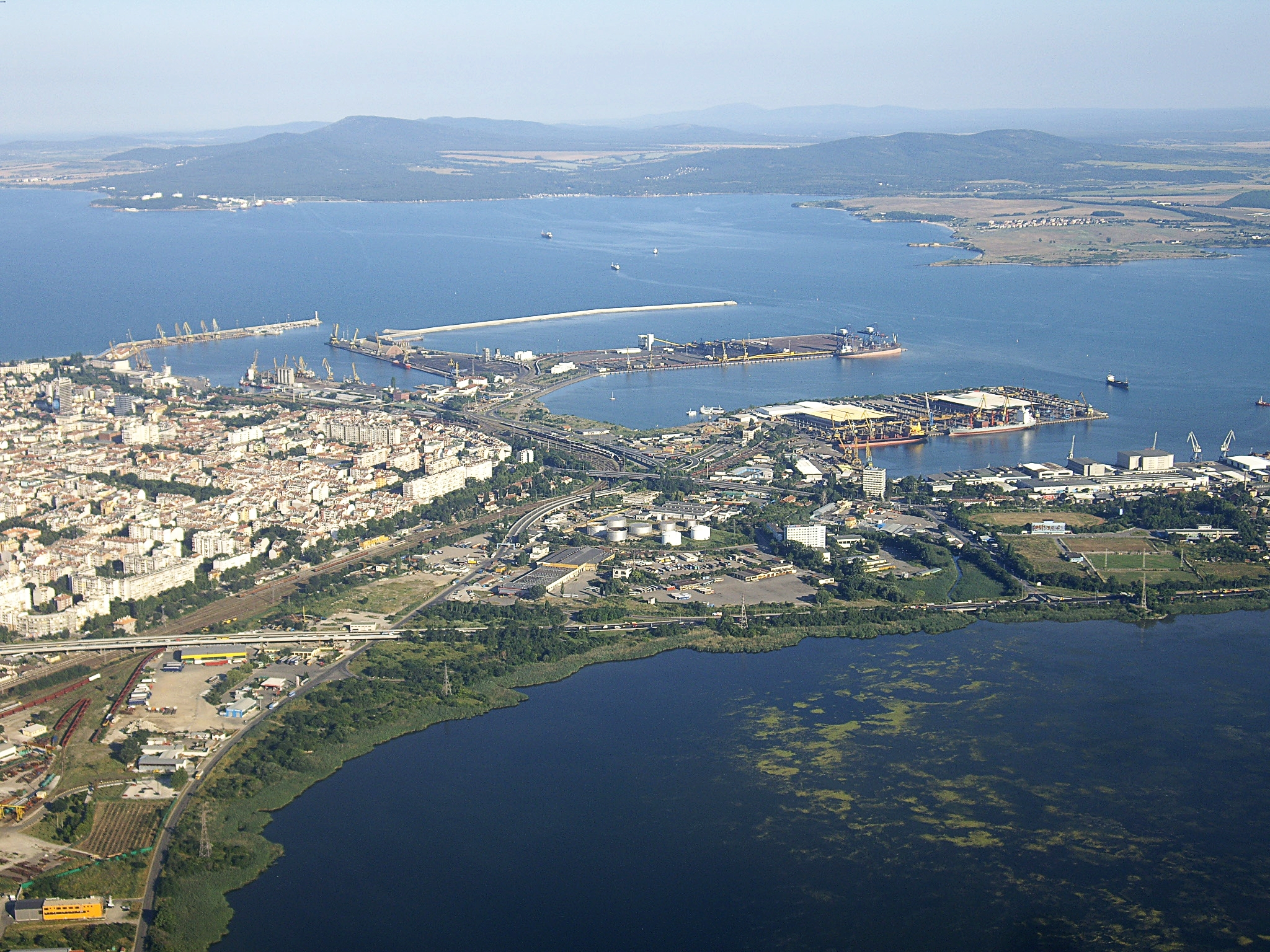
(picture by Vammpi at Wikimedia Commons)
What to expect?
A pretty nervy day with an obvious bunch sprint.
With that out of the way, on with the show.
After last year’s anomaly in Albania, RCS returns to its favourite kind of stage to have in a foreign Grande Partenza: a flat sprint.
Map and profile
Start
WARNING: a lot of talk about history, even by my standards.
For the Grande Partenza proper, RCS and the Bulgarian government have selected the town of Nessebar. At a population size of just over 13000 inhabitants, it may seem a surprising choice at first. However, it makes sense once you realise that it is located in the heart of Bulgaria’s most touristic region, a stone’s throw away from the resort town called Слънчев бряг in Bulgarian but well-known abroad by its English translation: Sunny Beach. I’m surprised that the race doesn’t so much as pass through it, but perhaps the Bulgarians wanted to show that their Black Sea coast is more than a destination for cheap beachside booze.
For that purpose, they couldn’t have picked a better spot than Nessebar. Its location just off the coast on an island (which has since been connected to the mainland by a causeway) made for a perfect combination of accessibility and defensibility, hence the site was settled very early (12th century BC or prior) by the Thracians, the region’s original inhabitants. The town, then known as Mesembria, grew significantly after the arrival of Greek colonists in the 6th century BC. Various Greek sources, including Aristotle, record Mesembria as being the birthplace of the famous fable writer Aesop, although his supposed birthdate (it is debatable whether an Aesop ever existed) predates colonisation.
In the late 6th century, the western Black Sea coast was occupied by the Persians, who retained control until they were forced out of Europe by the Greeks in the decades after the failure of the second Persian invasion of Greece in 489 BC. The Thracians now organised themselves into an organised state for the first time: the Odrysian kingdom, roughly overlapping with modern Bulgaria. Ties with Greece became increasingly close, and during the Peloponnesian War, the Odrysians wound up fighting on the side of Athens. Mesembria itself even became a member of the Athens-led Delian League.
The Peloponnesian War reshaped the wider Greek world, both because it broke the power of Athens and because the devastation permanently weakened large parts of Greece. Even in modern Bulgaria, which was peripheral to the conflict at most, the failure of the side it had been allied to had a major impact from the end of the war in 404 BC onwards. The Odrysian kingdom gradually disintegrated, and the territory was swept up by the Macedonians between 342 and 340 BC. After the death of Alexander the Great, a new power vacuum emerged, into which the invading Celts stepped. They would hold sway for most of the 3rd century BC, but the Thracians had regained the upper hand by the time the Romans entered the region in the next century, and would rule what is now Bulgaria as Roman client kings until annexation in 46 AD.
In the later Roman period, Mesembria grew in importance again, partly because the centre of power shifted closer to Thrace when Constantinople was established as the capital, partly because its defensible nature became more important as barbarian raids became more frequent. The first half of the Migration Period is by far the better known, as it led to the collapse of (the western half of) the Roman Empire. But while its effects on this region, too, cannot be understated, it is the second half where Bulgaria emerges as a distinct entity. In the late 6th and early 7th century, most of the Balkans were settled by the South Slavs, taking advantage of a Byzantine Empire occupied by its final and most devastating wars with Persia. In the 7th century, they were followed by the Bulgars, a Turkic people. The Bulgars had briefly held a large nomadic empire on the northern side of the Black Sea at the start of the century, but after its disintegration, some tribes migrated westward, reaching the Danube delta by the 670s. The Byzantines attempted to check this advance, but were defeated and forced to accept the establishment of the First Bulgarian Empire, which initially only partially coincided with modern-day Bulgaria as it was centred around the lower Danube. The areas further south, including Mesembria, remained Byzantine. The Bulgars dominated the new empire politically, but the population was majority Slavic, which explains why Bulgaria speaks a Slavic language today.
By this time, Arab power had reached its zenith, wiping Persia off the map and threatening to do the same with the Byzantine Empire. The Byzantines were embroiled in a series of civil wars at this time, one of which had seen the Bulgarians enlisted in a successful bid by a deposed emperor to reclaim his throne. The upshot of all this was a treaty in 716, which expanded Bulgarian territory further into modern-day Bulgaria (leaving Mesembria as the northernmost Byzantine outpost on the Black Sea), but also ended hostilities for the time being. This proved critical, as the Arabs besieged Constantinople for the second time the year after. Partially because of this agreement, partially because of successful Byzantine diplomacy, and partially because the Bulgarians were well aware that they were next in line if Constantinople were to fall, a Bulgarian army was dispatched to help break the siege. In conjunction with Byzantine naval superiority and a harsh winter, the Arabs were defeated. They would never come this close to capturing Constantinople again, and the Byzantine Empire would remain a shield behind which large parts of Europe could hide from Muslim expansion until the end of the Middle Ages.
Thus started a centuries-long cycle of alliances, wars and truces between the Bulgarians and the Byzantines. Most of the 8th century saw the latter regain the upper hand, but fail to land a decisive blow in spite of Bulgarian internal strife. By the end of the century, said instability had been ended under the rule of Kardam, who forced the Byzantines into a disadvantageous treaty in 792. Kardam was succeeded by Krum, who was so successful that his name remains in use as a given name in Bulgaria today (someone should have told J.K. Rowling that it’s not a surname, though). By the end of Krum’s reign in 814, he ruled what is now Romania, Moldova, the eastern half of Hungary and the northern half of Serbia (although control north of the Danube was much looser). In Bulgaria, he captured Serdica (modern-day Sofia) and massacred the Byzantine garrison in 809. The ensuing Byzantine counter-campaign succeeded in sacking the Bulgarian capital at Pliska in 811, but the army was forced to retreat and then successfully ambushed by Krum. The Byzantine emperor, Nicephorus I, was among the many who were killed. The Bulgarians were then able to capture Mesembria the year after, leaving Plovdiv and its surroundings as the only part of modern-day Bulgaria outside their control until this area, too, was captured in the 830s, alongside further expansion in the Balkans.
The First Bulgarian Empire was now near its zenith. Although the Byzantines were able to hold their own, even regaining control of Mesembria for a few decades, the Bulgarians were stronger militarily and experienced a period of economic and cultural prosperity by the standards of the age. The 9th century is notable for the invention of the Cyrillic script, and the conversion to Christianity under Boris I, but it is not until the reign of Simeon the Great between 893 and 927 that the Empire reached its true peak. While control north of the Danube seems to have definitively ended by this point, this was easily offset by major gains in the Balkans – by the end of Simeon’s reign, the borders extended as far west as Sarajevo and the Albanian coast. In addition, Bulgaria was now the most important centre of literature and religion in the Slavic world. Prosperity continued under Simeon’s son Peter I, but military success very much did not. In 966, the Byzantines allied with the Kyivan Rus’, and the latter overran modern-day Bulgaria, which was now reincorporated into the Byzantine Empire after the alliance with Kyiv turned sour. Although there was a revival in the surviving Balkan half of the First Bulgarian Empire, and control over much of the east was re-established for a while, this resurgence was only temporary. In 976, Basil II ascended to the Byzantine throne. His 49-year reign was to be the longest of any Roman or Byzantine emperor, and his epithet the Bulgar Slayer should tell you all you need to know about the fate of the First Bulgarian Empire.
Basil II is generally regarded as one of the best Byzantine emperors, but his death precipitated a long period of internal strife and misrule, culminating in the loss of virtually all of its Asian territories after what is often regarded as the most disastrous defeat in their history, Battle of Manzikert in 1071. While there was a final major resurgence from 1081 onwards under the Komnenian dynasty, the Byzantine Empire was permanently weakened in all aspects by this loss. When the so-called Komnenian Restoration came to an end with the death of Emperor Manuel I in 1180, the Byzantines proved unable to survive another bout of prolonged civil war. By the time this tailspin culminated in the Sack of Constantinople in 1204, the Bulgarians had already taken advantage of the situation to reestablish their independence. The Sack was greatly advantageous to them, as neither the Latin Empire established by the former Crusaders nor the surviving fragments of the Byzantine Empire were particularly strong, and if vassal states are included, the size of this Second Bulgarian Empire approached that of the First under Simeon in the first half of the 13th century.
However, this state, too, would not survive forever, and its decline started as early as the mid-13th century. To the south, the Byzantines regained control of Constantinople in 1261 and were somewhat resurgent, among others recapturing Mesembria in 1263. Even so, this final incarnation of the Byzantine Empire was a shell of its former self, and for both states, the real threat lay elsewhere. During this time, Bulgaria suffered from repeated invasions by both the Hungarians and the Mongol hordes, briefly becoming vassals of the latter at the end of the century. In 1300, Bulgarian authority was reasserted once more, with Mesembria retaken in this period of rebound, but by this point the balance of power had shifted so much that a Bulgarian-Byzantine alliance proved unable to contain Serbia. More importantly, the Ottomans were starting to rise in earnest. The Byzantines were the first of the two to come into conflict, but the already-disintegrating Second Bulgarian Empire would be the first to fall, at the close of the 14th century. Mesembria did not yet fall under Ottoman control, having been returned once more to the Byzantines by the Savoyard crusaders (who had been supposedly dispatched to fight the Ottomans, but wound up mostly attacking the Bulgarians) in 1366 and only being annexed in 1453.
The Ottoman period was neither kind to Mesembria nor to Bulgaria in general. In spite of Ottoman military and economic success reaching its zenith in the 16th and most of the 17th centuries, this time was characterised in Bulgaria by population decline (which had started during the slow unravelling of the Second Bulgarian Empire, was initially reversed after the Ottoman conquest, then resumed in the 17th century) and the forced integration of the Bulgarian Orthodox church into the Greek Orthodox equivalent. Mesembria itself had suffered from multiple sackings, and had been chained to the corpse of the Byzantine Empire while the Ottomans developed their own structures elsewhere along the coast. While there is still significant construction in the old town dating back to the Ottoman era, the town’s significance was clearly reduced by this point.
That allows me to turn to the latter half of Ottoman rule in Bulgaria. The long age of Ottoman expansion was definitively ended at the Battle of Vienna in 1683, and the remainder of the Ottoman Empire’s history is characterised by the weakening of the state and the gradual loss of territory. The loss of authority helped create the conditions for the rise of Bulgarian nationalism in the 19th century. The Bulgarian church seceded from the Greek – with the blessing of the sultan, but very much not that of the Patriarch – in 1870. However, this did not put an end to dissatisfaction, and things came to a head throughout the Balkans after the Ottomans increased taxes upon defaulting on their loans in 1875. Bulgaria was not the only place where this led to an uprising, and this particular April Uprising was neither large nor well-planned enough that it should have been more than a footnote in history. Indeed, the Ottomans were able to put it down fairly easily… but did so by massacring tens of thousands of civilians. These crimes against humanity were well-published in Britain, which had a long-standing alliance with the Ottoman Empire against the Russian Empire, in particular, and caused an outcry. As this was the late 19th century, the response was to gather the Great PowersTM at a conference, who demanded autonomy (under joint Ottoman-conference participant control) for both Bosnia and Herzegovina and Bulgaria (in typical fashion, North Macedonia was controversially lumped together with the latter). The Ottomans refused these demands, giving Russia a pretence to declare war once more. With Britain withholding support, the outcome was predictable. In fact, the Ottomans performed so poorly that they were pushed back to the outskirts of Constantinople, forcing Britain to deploy its navy to prevent a complete collapse. The trade-off was that the Ottomans agreed to worse terms than those they had previously rejected, and the newly-established Principality of Bulgaria (not including North Macedonia) was an Ottoman vassal in name only.
While many, not least the Russians themselves, had expected the new state to become a Russian vassal in practice, this was very much not the case. The new Bulgarian state was interested in territorial expansion, which caused tension with – among others – Russia’s ally Serbia, who also had plans to annex North Macedonia. Russia attempted to reverse this unwanted surprise with a coup d’etat in 1886, but this failed. Bulgaria remained underdeveloped and impoverished at the time of independence, but the next few decades saw the onset of urbanisation and especially militarisation. The Ottoman Empire was continuing to unravel, and Bulgaria was able to use the Young Turk Revolution in 1908 to declare full independence.
Shortly after this, Bulgaria signed a secret treaty with Serbia, Greece and Montenegro to push the Ottomans out of the Balkans entirely, and the four countries initiated the First Balkan War in 1912. By this point, the Ottomans were practically incapable of winning any sort of war and were forced to abandon everything west of more or less the modern Turkish border, but that was only part of the story. There had been no clear agreement on how to divide the conquered territories, and the Bulgarians, dissatisfied with the final outcome, almost immediately instigated the Second Balkan War. This backfired, as every single neighbouring country wound up joining forces and Bulgaria was forced to cede some of the gains it had made less than a year prior, and also led to further inflammation of tensions in the region. Serbia was now the main power in the Balkans, leading many Serbs to believe that they could annex not just North Macedonia, but also Bosnia and Herzegovina. Serbia was now the only Balkan ally of Russia, which had played its part in setting up the original treaty in a bid to prevent having to choose sides. Bulgaria was wounded, and with its other enemies also allied to the Entente, naturally turned towards the Central Powers.
The rest is sadly history. As we all know, the powder keg that was the Balkans exploded again less than a year after the conclusion of the Balkan Wars when Franz Ferdinand was assassinated by nationalist Serbs, and this time the rest of Europe decided that the best course of action was to get dragged into the war too. Still reeling from its losses the year prior, Bulgaria initially remained neutral. However, it did not take long until both the Entente and the Central Powers – which soon included the Ottomans, with whom Bulgaria had signed a mutual defence pact after the outbreak of war – started trying to induce Bulgaria to join the war on their side. The Allies needed Bulgaria because Serbia could not hold off Austria-Hungary on its own, the Central Powers needed Bulgaria to prevent the Ottomans from being cut off from the rest of the war. Ultimately, the Allies’ existing alliance with Serbia proved decisive, as this meant that the Central Powers were able to promise far more in terms of territorial gains. Bulgaria then entered the war on the side of the latter in the autumn of 1915, as the final member of what would henceforth often be referred to as the Quadruple Alliance.
The war initially went very well for the Bulgarians. Within two months, the Central Powers had occupied the entirety of Serbia and with it, North Macedonia, where the Bulgarians would commit various war crimes against the Serbs. Coupled with victories against Romania and advances into Greece, Bulgaria had achieved its territorial objectives by 1916. However, it had no way of bringing its involvement in the First World War to an end. Both the northern and southern fronts became mired in trench warfare, which required ever-greater numbers of soldiers to be sustained in the face of Allied reinforcements. By 1917, more than a quarter of the prewar population had been conscripted. It should therefore not come as a surprise that the war became increasingly unpopular among the general population.
This was a situation that could not hold, and it did not. Although the Central Powers secured a treaty with Romania as a direct consequence of Brest-Litovsk, this was more than offset by Allied plans in Greece, which had finally joined the war after three years of political and geographical division. In May 1918, Bulgaria lost a significant battle on the southern front near Thessaloniki, and could not strike back because its soldiers refused to participate in a counteroffensive. The political situation now also became chaotic, and when the Allies launched a full-scale offensive in September, the army mutinied. This rebellion was contained, in part because the tsar abdicated in favour of his son, but with the walls closing in on the Central Powers everywhere, there was no other option left than to sign an armistice. Bulgaria was forced to cede more territory, most importantly its Aegean coast, and to pay large reparations.
All these developments had a particularly significant effect on Mesembria. Through all the years of Bulgarian and Ottoman rule, it had remained one of very few places in the region that was culturally and ethnically Greek, as it had been for 25 centuries by this point. This situation did not survive the desire for ethnostates throughout the wider region and the subsequent forced resettlement (or, in many places, worse) of the people deemed on the wrong side of the border by both the government of the country they lived in and that of the country ruled by their brethren. In the case of the small Greek minority in Bulgaria, their fate was sealed by the post-WWI peace treaty, which contained a clause requiring population exchange with Greece. Most of the Greek population of Mesembria was settled in Greece around 1925, and the town was one of over 1000 rechristened with its current, more Bulgarian-sounding name in 1934. Nessebar was then resettled by Bulgarians, and the development of the new town on the mainland commenced.
But I’m getting ahead of myself here, because Bulgaria was far too unstable in the interwar period to allow me to jump seven years. In the immediate aftermath of the war, it became politically divided by the agrarians, the communists and the irredentists. As the Agrarian Party had vehemently opposed the war, it initially gained the upper hand, pursuing a platform of land reform and pacifism while also becoming more authoritarian. Conflict with the irredentists started to boil over quickly, culminating in a coup d’etat (supported by the tsar) in 1923. The Agrarian prime minister was tortured and murdered, and the new regime embarked on a terror campaign against both the agrarians and – following a failed uprising involving a terrorist attack that claimed 170 lives – also the communists that killed (possibly tens of) thousands. The tsar forced this government to resign in 1926, and its more moderate successor was defeated in the 1931 elections by a reconstituted opposition. This would be the final democratic elections in Bulgaria for 59 years. This government was overthrown by the military in 1934, who were in turn removed from power the year after by the tsar, who now asserted control.
The Second World War played out for Bulgaria in a remarkably similar way to the first. Once again, it initially remained neutral, but the country was economically dependent on Germany and the Nazis used this fact to pressure the Bulgarians into once again joining the war on the side of
Germany, once again dangling territorial gains in Macedonia as a carrot. And once more, too, Bulgaria occupied significant parts of Greece, North Macedonia and Serbia. However, there was a key difference: this time, Bulgaria had never really been a willing participant in the war. It did not declare war on the Soviet Union, and while antisemitic laws had started to be introduced even prior to participation in the war and most of the Jewish population in the occupied territories was deported to extermination camps, the Jews in Bulgaria proper were mostly spared this fate (although they suffered great hardships and mostly emigrated after the war). By 1943, Bulgaria was looking for a way to break with the Nazis, but the situation was complicated by the sudden death of the tsar. His heir was his six-year-old son, hence there was something of a power vacuum.
By the summer of 1944, the Red Army was firmly on the move. Bulgaria tried to restore its neutrality, with the pro-German elements forced out of government and a formal withdrawal from the Axis, but the Soviets invaded regardless in September. That same day, the government was overthrown by yet another coup d’etat, this time by the pro-communist resistance. Interestingly, both the 1934 and 1944 overthrows of government were headed by the same person, Kimeon Georgiev, in spite of the vastly different political colour of both. The Soviets were firmly in control, however, and hundreds of thousands of Bulgarians were once again conscripted to fight on the Allied side in the remainder of the war. In 1946, the young tsar was forced into exile with a communist dictatorship installed.
The ensuing 34 years of communist rule more or less write themselves, as they were by and large little different from the other countries in the Soviet sphere of influence. Urbanisation and industrialisation were rapid, with even a smaller town like Nessebar quadrupling in size during this period. After the fall of Stalinist elements in 1956, the country was de facto under the rule of Todor Zhivkov, who usually positioned Bulgaria slightly more liberally than was the norm in the Warsaw Pact countries. In the 1980s, he embarked on a policy to forcibly assimilate the still sizeable Turkish minority. This led to 300000 of the 800000 Turkish Bulgarians either fleeing or being driven out of the country in 1989. This proved to be his undoing: already at odds with Gorbachev and with protests throughout the Eastern Bloc spreading to Bulgaria, he was forced out of power in November. Turkish repression was ended, and the following year saw the successor of the communist party win the first free elections in over half a century.
As in the rest of post-communist Europe, the fall of communism meant that years of economic stagnation initially turned into a deep crisis that lasted for most of the 1990s, with hyperinflation (which was eventually contained) and corruption (which remains a major issue to this day) exacerbating the issues caused by the shock to the old economic system. By the turn of the millennium, Bulgaria was firmly on the road to recovery. In 2001, an interesting quirk happened: Simeon II, the tsar who had been exiled 55 years prior, was elected prime minister, and under his government, Bulgaria joined NATO and EU accession negotiations were concluded. In spite of the advancements made in the past decades, Bulgaria remains both the most corrupt and the lowest-wage country in the EU. This goes some way as to explaining the extreme political instability the country has experienced in recent years, with no fewer than eight parliamentary elections being held since April 2021 – although last month’s elections returned an outright majority for former president Radev, which should mean an end to five years of political crisis if nothing else.
And what about Nessebar? It has done quite well for itself in modern times, with the well-preserved old town being UNESCO-inscribed in 1983 and the fall of the Iron Curtain having accelerated its touristic developments.
(picture by Andrzej Wolinski at Panoramio, reuploaded to Wikimedia Commons)
The route
Confession: by the time I’d finished writing the above, I had forgotten entirely that I also had a race to write about. Whoops. To everyone who skimmed over it, I’m sorry but also not really.
Either way, on with the show. Nessebar and Burgas, the location of this stage’s finish, are close enough together that they could have been connected by a time trial. So naturally, we… take the shortest possible route there? We reach the city centre less than 40 kilometres into the day, barely avoiding passing the finish line from the opposite direction, before embarking on an out-and-back section down the other half of the Burgas Bay coastline. After another 30 kilometres, we then hit a circuit that is repeated twice, before taking the same way back into Burgas – it really doesn’t feel like the way a GT would set up a route, but clearly the funds for repaving roads weren’t enough for three normal stages.
On this circuit, we have a token KOM at Cape Agalina (Нос Агалина), registering particularly high on the Relus ter Beek Scale of Bad Excuses To Kickstart The KOM Competition because for some reason both ‘ascents’ (1.2k at an eye-watering 2.2%) count. In addition, there is the intermediate sprint in Sozopol (Созопол), originally Nessebar’s rival Greek colony in the area and now its rival cultural tourist destination, on the first lap, and the bonus sprint (I’m not calling it the Red Bull Kilometre, thank you very much) on its outskirts on the second lap. Immediately after the latter, the riders embark on their return journey into Burgas.
Finish
It’s a bit of a strange one. There are a couple of corners to stretch things out, but the last one comes at 3 kilometres to go. After that, the route is characterized by gradual bends and some slightly uphill sections, the most significant of which is 450 metres at 3.7% and is crested at 800 metres from the line. One important thing to note that isn’t clear from the official material at all is that there’s a narrowing at the flamme rouge that lasts all the way until that final sweeping curve at 300 metres to go. The final straight itself is flat.
Although it has grown to be the fourth-largest city in Bulgaria, Burgas is a relatively young city. It is not clear when the site was first settled, but there was definitely nothing that could be considered a town until the Ottoman navy started to use its port in the early 17th century. Shipbuilding and the development of cereal trade followed, and Burgas had become one of the main Ottoman Black Sea ports by the 19th century. Even so, its population stood at only about 5000 people at the time of independence. In the decades that followed, Burgas became one of the cornerstones of the nascent urbanisation and industrialisation, with the railway arriving in 1890 and a deep water port being opened in 1903. This was coupled with large-scale urban development, and the city centre today is still dominated by late 19th and early 20th century buildings.
As discussed, the 20th century was often tumultuous for Bulgaria, but Burgas continued to grow almost uninterruptedly. Early 20th century population growth was fuelled in significant part by the arrival of Bulgarians from the now-Greek and Turkish parts of Thrace in the wake of the aforementioned forced population exchanges. A disproportionate number of these migrants/refugees settled in Burgas and its surroundings. The interwar period was also notable because it saw Burgas definitively overtake Varna to become the main port in Bulgaria. In the communist era, the development of the port was furthered by the introduction of an oil refinery and chemical industry. Modern-day Burgas sits at around 200000 inhabitants, with an economy relying mainly on its port, industry, and its function as a base for the touristic coast.
(picture by Vammpi at Wikimedia Commons)
What to expect?
A pretty nervy day with an obvious bunch sprint.
Last edited:


 Facebook
 Twitter
 Instagram