


- Sep 12, 2022
- 10,287
- 11,535
- 22,180

The Volta a la Comunitat Valenciana occupies a distinguished position within the professional cycling calendar, serving as an early-season litmus test for the world’s elite riders as they transition from winter training blocks into high-intensity competition. The 2026 edition, scheduled to take place from February 4 to February 8, continues the race's legacy traversing 601.7 kilometers across the rugged and varied terrain of the Valencian Community.
Route
Stage 1 - Segorbe › Torreblanca
The race commences in the province of Castellón, moving from the inland historical town of Segorbe to the coastal municipality of Torreblanca. This 160-kilometer stage is designed as a hybrid test, offering enough elevation gain to challenge the pure sprinters while providing a fast finish suitable for a reduced peloton or a late-race attack. The primary topographical feature of the opening day is the Alto de los Madroños, a third-category mountain pass crested at kilometer 126.6. This ascent, followed by the rolling hills around Oropesa in the final 40 kilometers, serves as the initial filter of the race.
Historical patterns in the province of Castellón suggest that early-stage aggression often leads to breakaways that can be difficult to manage on the technical, winding roads of the interior. However, with WorldTour teams like Lidl-Trek and NSN Cycling Team present, the tactical impetus will likely favor a controlled chase to set up finishers like Mads Pedersen or Biniam Girmay.


Stage 2 (ITT) - Carlet › Alginet
The 2026 edition marks the strategic reintroduction of the individual time trial (ITT), a discipline that has historically played a decisive role in the general classification of the VCV. The 17.5-kilometer course between Carlet and Alginet is situated in the heart of the Ribera Alta region, providing a high-speed but technical challenge.
The Carlet-Alginet ITT is not a traditional flat course. It features an initial technical phase through urban and suburban infrastructure, followed by a demanding 3-kilometer climb that requires riders to maintain aerodynamic efficiency under high metabolic stress. This is followed by a fast descent into Alginet.
The presence of Remco Evenepoel fundamentally alters the race dynamics. For GC contenders like João Almeida or Antonio Tiberi, the objective will be to minimize time losses against the World Champion. The time gaps established in Stage 2 will dictate the level of aggression required in the subsequent mountain stages, as climbing specialists will be forced to launch long-range attacks to reclaim lost seconds.

Stage 3 - Orihuela › San Vicente del Raspeig
The third stage moves the competition into the province of Alicante, connecting the historical center of Orihuela with the university town of San Vicente del Raspeig. The 158-kilometer route is a study in contrasting landscapes, beginning with 100 kilometers of flat roads through the Vega Baja del Segura before entering the rugged interior.
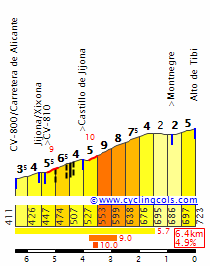
The defining ascent of Stage 3 is the Alto de Tibi, a second-category pass located at kilometer 120.2. The climb itself is 4.7 kilometers long with an average gradient of 7.1% and maximum ramps of 9.8%.
| Statistic | Alto de Tibi Profile |
| Length | 4.7 km |
| Average Gradient | 7.1% |
| Maximum Gradient | 9.8% |
| Elevation Gain | 292 m |
| Top Altitude | 737 m |
| Category | 2 |
The positioning of the Tibi pass, approximately 35 to 38 kilometers from the finish, creates a tactical dilemma for the peloton. The first 100 kilometers passing through Algorfa, Guardamar del Segura, and Santa Pola are susceptible to crosswinds and high speeds, potentially thinning the pack before the climbs begin. Following the Tibi ascent, the route passes through Agost and concludes with a sustained descent toward San Vicente del Raspeig. In previous editions, similar finishes in the Alicante province have rewarded riders who can survive a moderate climb and maintain high speeds on technical descents.


Stage 4 - La Nucía › Teulada Moraira
Stage 4 is the undisputed "Queen Stage" of the 2026 VCV, featuring five mountain passes and an accumulated elevation gain of 3,225 meters. Starting in La Nucía, the 172-kilometer route traverses the heart of the Marina Alta, a region synonymous with professional cycling training and topographical brutality.
The most formidable obstacle of the day is the Alto del Miserat (Pico Xillibre), a first-category climb located approximately 100 kilometers from the finish line. Despite its distance from the end of the stage, the Miserat is designed to permanently split the general classification group.
| Feature | Alto del Miserat (from Pego) |
| Distance | 6.6 km |
| Average Gradient | 10.1% |
| Vertical Ascent | 661 m |
| Steepest 100m | 21% |
| Difficulty Score | 871 |
The Miserat is a climb of inconsistent and punishing ramps, featuring a 1.6-kilometer section averaging 15.6% gradient. Historically, this climb has a reputation for being "a horror," with concrete surfaces on the final push to the summit where the Pico Xillibre communications tower is located. In the 2024 edition, the Miserat was used as an uphill finish due to route relocations, where Brandon McNulty demonstrated his dominance by soloing to victory and securing the race lead. In its 2026 mid-stage placement, the Miserat will serve as a point of attrition, isolating team leaders before the technical final circuits.
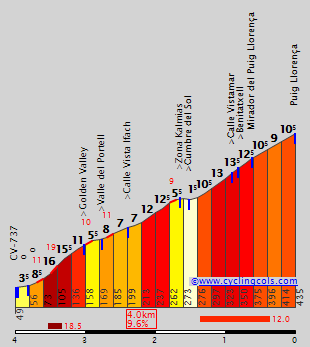
The final 25 kilometers of the stage are characterized by high-intensity "punchy" climbs that favor explosive climbers and puncheurs. The ascent to the Puig de la Llorença (Cumbre del Sol) in Benitachell is a 2 to 3.3-kilometer effort with gradients reaching 18%.
Following the Cumbre del Sol, the race descends toward the coast before encountering the Muro del Pou, a savage kicker with ramps of 22% located just 5 kilometers from the finish line in Teulada Moraira. This final sequence ensures that the winner of the Queen Stage must possess the endurance to survive the Miserat and the anaerobic capacity to conquer the double-digit gradients of the finale.


Stage 5 - Bétera › Valencia
The final stage of the 2026 VCV is a short, explosive 94.7-kilometer leg from Bétera to the heart of Valencia. This stage has become a modern classic, utilizing a route that is almost a carbon copy of the 2023 and 2024 finales, both of which were won by tactical breakaways rather than mass sprints.
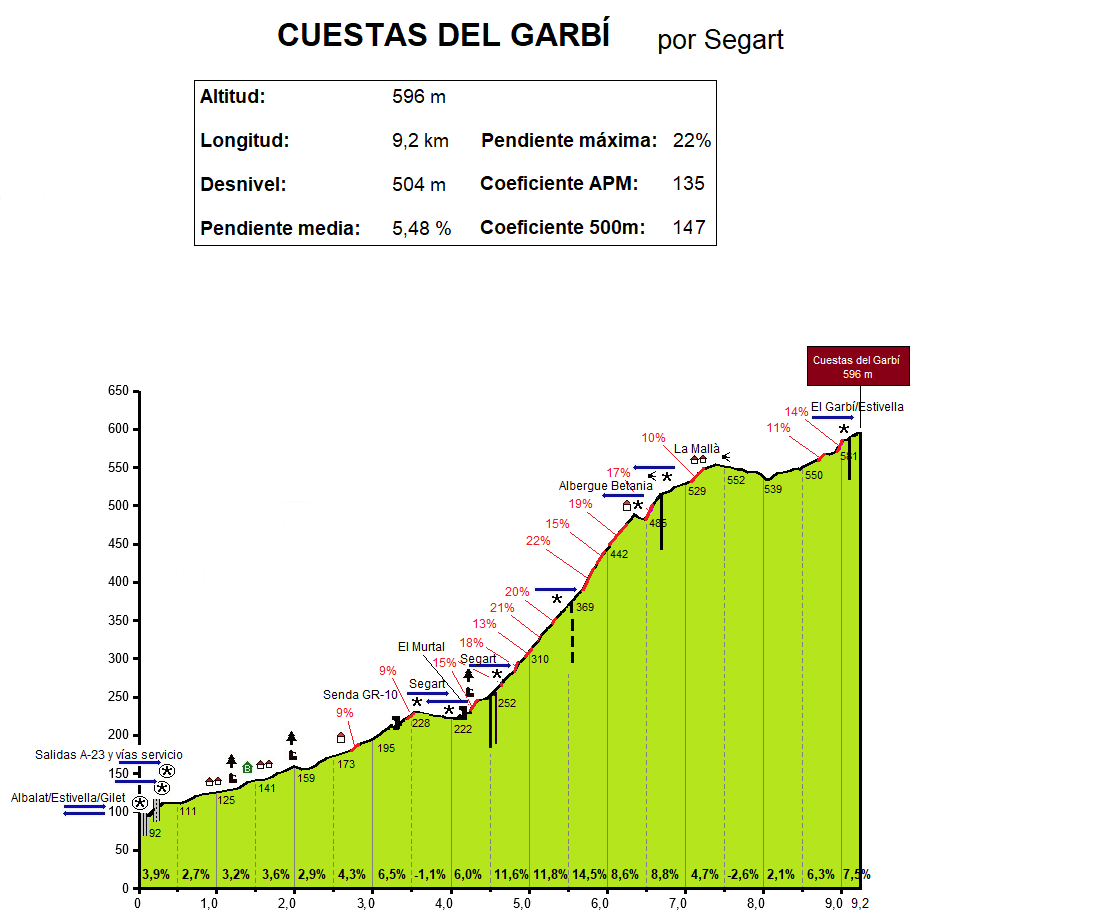
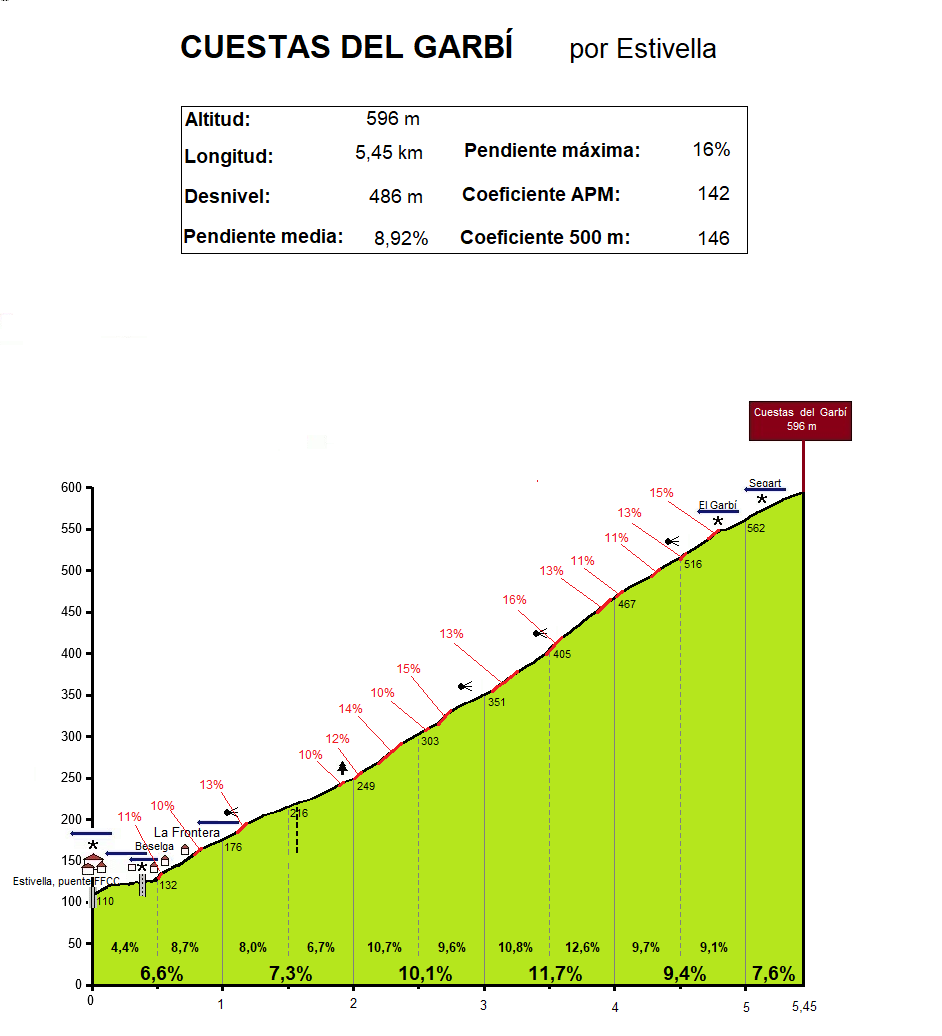
The outcome of the race in Valencia is traditionally decided by the Puerto del Garbí, a first-category climb situated at kilometer 50.8. The climb provides the ideal terrain for a long-range attack.
In 2023, the Garbí was the site of a legendary tactical duel. Rui Costa, trailing in the general classification, launched a late-stage attack to bridge to the front group on the descent, eventually out-sprinting Thymen Arensman to secure both the stage and the overall title from Giulio Ciccone. In 2024, Will Barta attacked from the breakaway on the Garbí and managed to hold off the elite peloton for a solo victory, while Brandon McNulty successfully defended his yellow jersey. The finish at the Marina in Valencia provides a high-speed coastal backdrop to the final classification honors.


Competitive Field: 2026 Teams and Contenders
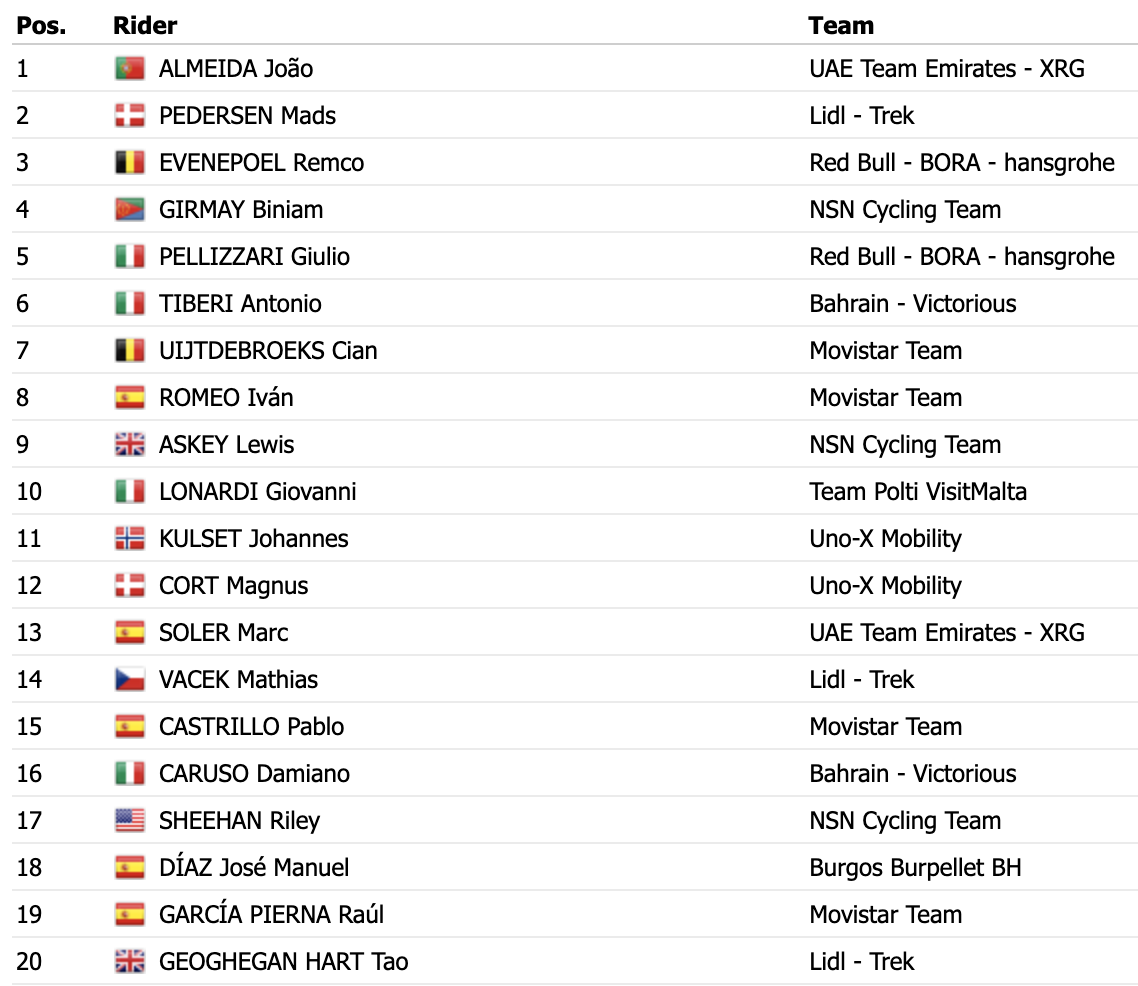
The 2026 startlist features a significant concentration of talent, with nine UCI WorldTeams and a strong contingent of ProTeams. The diversity of the route, combining an ITT with extreme mountain gradients, ensures a multifaceted tactical battle between time-trial specialists and pure climbers.
DISCLOSURE: I've written this whole post with AI. Wanted to test the research function of Gemini and see how good it is for threads like this. Feel free to give feedback on it's content, not on the fact it's written by AI.
Last edited:

































 Facebook
 Twitter
 Instagram