Malaysian Flight 370?

Page 7 - Get up to date with the latest news, scores & standings from the Cycling News Community.

What happened to Malaysian Flight MH370?

  • Wormhole

    Votes: 1 100.0%

  • Total voters
    1
Jul 18, 2010
1,314
41
10,530
Ocean Infinity's search vessel steamed around for a couple of weeks then gave up (apparently having found nothing) and went back to Singapore. They're not communicating with the world (not that I can find anyway) but Malaysian government sources say they quit because the weather wasn't suitable but they'll be back later in the year.

IMHO it doesn't speak to highly of OI's planning capabilities that they hadn't checked the weather before deciding to travel there and set up shop.

I've found no end of 'click-bait' sites purporting to offer the latest on MH370 but the only one I check any longer is the YouTube channel of Australian aviation boffin, Geoffrey Thomas. Thomas' daily guest-commentator is the inventor of using WSPR technology to track planes in flight, Richard Godfrey, so they don't lack for expertise.

Most days their 'show' is fluff like viewer polls and answering naive questions from viewers but on occasion they do have detail I don't think you'll find elsewhere.

One thing I've learned from them is that Godfrey's WSPR tracking technique has been subjected to several "blind" tests. He's been given an airport, the departing runway and the time of take-off and without fail he's been able to correctly detail the path of flight and destination airport, without so much as knowing the flight number. Which significantly raised my estimation of the odds that he might be right about the possible crash area. Whether that leads to finding the wreckage, time will tell.
 
  • Like
Reactions: movingtarget
Sep 5, 2016
5,354
8,553
23,180
Ocean Infinity's search vessel steamed around for a couple of weeks then gave up (apparently having found nothing) and went back to Singapore. They're not communicating with the world (not that I can find anyway) but Malaysian government sources say they quit because the weather wasn't suitable but they'll be back later in the year.

IMHO it doesn't speak to highly of OI's planning capabilities that they hadn't checked the weather before deciding to travel there and set up shop.

I've found no end of 'click-bait' sites purporting to offer the latest on MH370 but the only one I check any longer is the YouTube channel of Australian aviation boffin, Geoffrey Thomas. Thomas' daily guest-commentator is the inventor of using WSPR technology to track planes in flight, Richard Godfrey, so they don't lack for expertise.

Most days their 'show' is fluff like viewer polls and answering naive questions from viewers but on occasion they do have detail I don't think you'll find elsewhere.

One thing I've learned from them is that Godfrey's WSPR tracking technique has been subjected to several "blind" tests. He's been given an airport, the departing runway and the time of take-off and without fail he's been able to correctly detail the path of flight and destination airport, without so much as knowing the flight number. Which significantly raised my estimation of the odds that he might be right about the possible crash area. Whether that leads to finding the wreckage, time will tell.
Travel is very complicated, many large vessels could possibly get fuel and re- fortified but the logistics are super expensive and complicated. Usually for military or major government budgets exclusively. If the ship is not prepared to steam passed weather systems that usually means that they just went out prepared for best case scenario. Many military battle groups have ships of various displacements, sizes and they stay in and encounter foul weather as normal operation. No Captain wants to navigate in and around storm conditions but they do it routinely. In short, not a big deal, business as usual.
I don't have any idea of what type of device(s) would be deployed to the depths to look for the aircraft, but I highly doubt that they are tethered to the ship..so you need a few things, decent weather to launch, extended capability of search craft and decent weather for recovery.. So if a storm was going to last for 5,6+ days and the drone or submarine can't stay submerged for extended period it would make sense to turn around.. The capabilities of large ships are all weather but doing launch and recovery might not be possible during storm conditions..
I personally have never seen large ocean vessels run out of gas, or run from medium size storms.
Some examples were launching and recovering a remote vehicle might be hard...
View: https://m.youtube.com/watch?v=cMNH4nmOims&pp=ygUXU3Rvcm0gY29uZGl0aW9ucyBhdCBzZWE%3D
 
Jul 18, 2010
1,314
41
10,530
No sooner had the Ocean Infinity vessel left the search area than a Chinese-flagged research vessel arrived.

The ship previously had been in New Zealand waters doing marine research and once that was concluded they sailed west past the Great Australian Bight and into the Indian ocean. They supposedly were there to doing multi-beam sonar mapping of a feature of the ocean floor called "Broken Ridge," which might well be the truth and the whole truth.


2505080152350155.png


However, Broken Ridge is EXACTLY where U. of Tasmania scientist Vincent Lyne has predicted MH370 will be found.

Lyne describes Broken Ridge as a a 20,000-foot sea floor hole surrounded by high ridges and other deep holes, the "perfect 'hiding' place" for the aircraft. These "canyons" also likely are full of silt, which would be stirred up by a high-speed impact such as a relatively intact airframe gliding such a great distance in the water, and the settling ejecta would fall on top of it and camouflage its final resting place.

Not only do I find it odd that the Chinese are able to conduct similar research in weather that Ocean Infinity found unsuitable -- which, I will admit, could be as simple as the differences in the sensor packages they're using -- but the focus of the Chinese search (Broken Ridge, 31°S, 95°E) is only 132 nautical miles, 245 km, from the ground zero of Richard Godfrey's WSPR-predicted crash site at 33.177°S 95.300°E.

It's an awfully big ocean and a difference of only 245 km is awfully suspicious, especially if you consider both are searching over an area of probability, not looking for a mere pinpoint, so the actual difference is considerably less.
 
Jul 18, 2010
1,314
41
10,530
I don't recommend watching this except for the most anoraki of MH370 news addicts but a couple of days ago YouTuber Geoffrey Thomas had on as his guest commentator American barrister-turned-adventurer and now MH370 sleuth Blaine Gibson, who has been the driving force behind much of the searching and recovery of bits and bobs from the crash. He has visited many of the likely locations for debris to wash up, encouraged the locals to search for evidence, and even offered rewards for anything recovered.

I bring this up now because the reason for his appearance on this particular podcast episode is to offer his opinion as to which are the 10 most important pieces of recovered debris either provably from or almost certainly to be from MH370. And the upshot is that in his opinion (and/or the analysis of the experts), all 10 of these items show evidence of a very high-speed impact (including pieces from the interior of the cabin), which, if correct, would contradict the theory of a controlled landing/ditching.

Host Geoffrey Thomas also notes near the beginning of the episode that according to his sources Ocean Infinity do intend resuming their search for the crash site come this November.
 
Jul 18, 2010
1,314
41
10,530
There was a YouTube episode on Airline News six days ago in which guest boffin (barrister-turned-explorer) Blaine Gibson stated that his understanding is that Ocean Infinity's search for MH-370 will resume some time this (Southern Hemisphere) summer. Previous reports were that they intended to return this month (November 2025) but now it appears it won't be until late December at the earliest. If you're interested to see it, this bit of the conversation starts about 8 minutes in.

Gibson also remarked that Ocean Infinity habitually plays their cards close to their chest because it both saves OI being bombarded with requests for details and avoids stirring up raw emotion among families and friends of the victims if they prepare for and conduct their searches as discretely as possible.

In the linked episode they do make mention of more debris having been found, piece #59, the 25th piece from the interior. Like much of the recovered debris, it was discovered by a fisherman who had no idea what it was. Which illustrates why Gibson's amateur work has been so vital to the investigation, because he personally visited many locations in the region where pieces had or were thought likely to come ashore, met with local community and constabulary officials to recruit their support, and offered a reward for any bits recovered.

They also discuss the absence of life vests from among the recovered debris, which they attribute to the strength of the seat mounts. In some 777s, the seats are made to remain attached to the seat rails in the floor in spite of forces as great as 16G. And since those life vests are stowed beneath the seats, if the seat remains intact, the vest underneath it isn't likely to be dislodged.
 
Jul 18, 2010
1,314
41
10,530
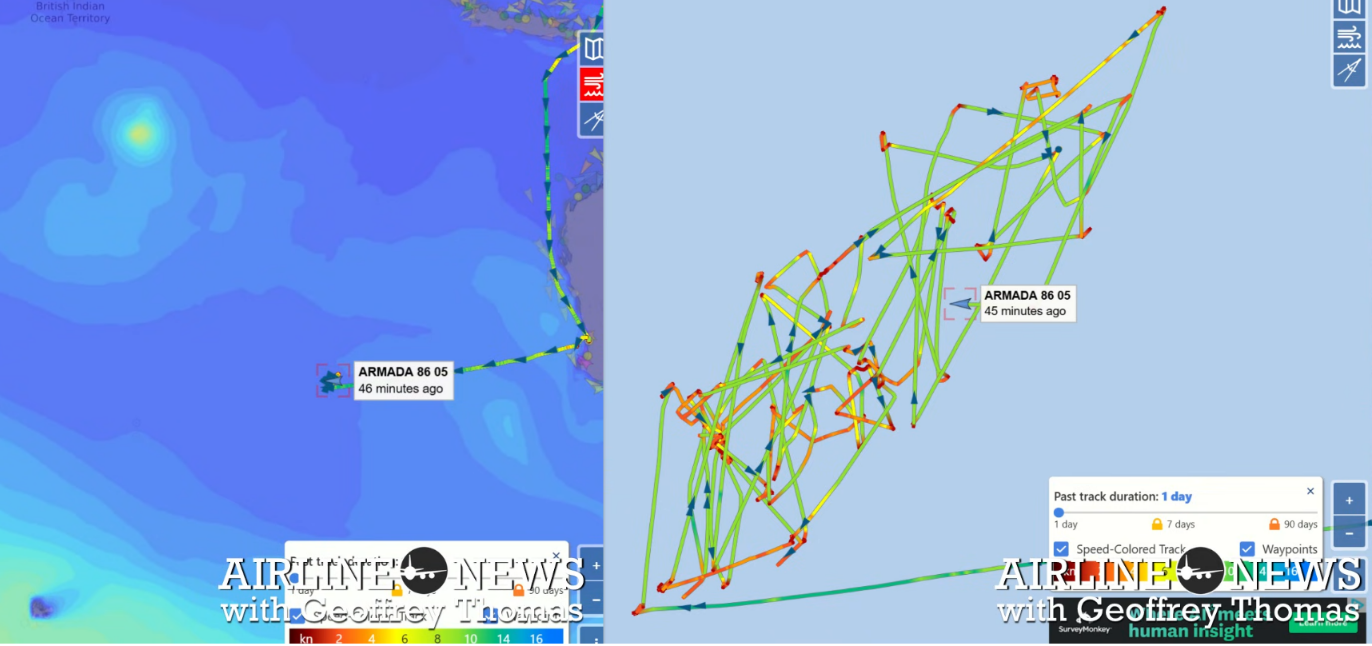
I screenshot the images below three days ago (sourced from Airline News with Geoffrey Thomas) so take no heed of the time references given.

mh370-search-screen-captures.png


The image at left is the location of the search area relative to the west coast of Australia. At right is the course of the search vessel.

I've not come across anything explaining why the ship's track is so higgledy-piggledy -- due to sea state, data-driven (following the clues), helmsman having a too many rations of grog, etc. -- but Geoffrey Thomas assures that the search pattern employed by the underwater drone is the more typical grid.

They did have a 48-hour search stand-down due to unfavourable sea state a couple of weeks ago, but the ship remained in the area.

I should note that the presenters on the Airline News YouTube channel have opined that the Malaysian government might have imposed a news blackout on Ocean Infinity, leaving the government as the sole source of news and information. The stand-down was only made public through a mention on the Facebook group created for the families of the passengers and crew of MH-370. Some of them had received that information directly from the government and relayed it to the group on FB. Some time back Ocean Infinity's CEO stated to the effect that he had no interest in any interaction with the media regarding the search, so I rather think he is grateful for any government-imposed gag order.

In Airline News's most recent installment, Thomas addresses the question of how so large an aircraft could be crashed into the sea but have only a few dozen bits and bobs ever recovered. To start, because the Malaysian government forsook its due diligence, it was 20 days after the disappearance before any search was mounted. Two cold fronts passed in those 20 days, strong winds from which would have distributed the floating debris over much of the Indian ocean. In fact there were four meter seas in the presumed crash area on the day of the incident.

There are tens of thousands of kilometers of beaches there that rarely receive a human footprint, and considering the state of development in the coastal areas of those countries ringing the Indian ocean, there are a great many people living there still to this day who have never heard of MH-370. So there might have been thousands of pieces of wreckage washed up -- now likely buried in the sand or washed back out to sea -- but not collected and turned over to authorities because the locals simply did not grasp its import.

Most of what few dozen pieces of wreckage that have been recovered and identified were the result of American barrister Blaine Gibson's efforts to inform locals in areas indicated by likely drift patterns, and his monetizing of search efforts by personally offering cash rewards. Plus, as Archimedes tells us, nothing floats that isn't buoyant, and carbonfibre isn't unless it encapsulates some void. Most of the pieces found are made of a honeycombed composite, which is buoyant only because of trapped air spaces within it.

To the best of my recollection, this is the first uncontrolled water landing of a wide-body airliner with an all-carbonfibre fuselage. The public's collective experience is tainted with the much larger body of knowledge regarding break-ups on impact with water of aluminium aircraft. However, monocoque carbonfibre is significantly stronger and the break-up of the airframe likely to have been less extensive than if it had been aluminium. Which might explain why no seat cushions, life jackets, or floaty bits of luggage have been found. Because it might remain captured within an intact cylindrical fuselage.

And if you're having trouble sleeping, about 10 minutes into today's installment Thomas gives a brief lecture on the state of development of autonomous underwater search and exploration vessels.
 
  • Like
Reactions: movingtarget