AHHHH, there has been so much physiological cliché bouncing around this poor kid's thread and now you had to add the BMI icing!So, Pogi and Jonas have the optimal height/weight/bmi...configuration



AHHHH, there has been so much physiological cliché bouncing around this poor kid's thread and now you had to add the BMI icing!So, Pogi and Jonas have the optimal height/weight/bmi...configuration
Kinda thought the same thing. Seems like we've been to the bottom of this Rabbit Hole and saw Alice headed back up.What?


































What what? Abi has been arguing that one or two kg more or less doesn't make much of a difference.What?

Please share your calculations.
A skinny man of 2m tall will be able to output significantly more power than a man of 1.5m tall who has the same fat percentage. Somewhere in between lies the perfect balance between power, weight and height. In the context of climbing you could assume the smaller the better, but both the tiny man and the taller man also have to carry the weight of the bike up the mountain, which in both cases has a minimum weight requirement. So if the tiny man weighs 45kg, for which his power output would be ideal, then you have to add to that another 10kg of bike, clothes, shoes, etc on top of his own weight, and suddenly his power/weight ratio isn't that great anymore. Percentage wise, this is less of an issue for the tall man who may weigh 65kg, as the added weight disturbs his power/weight ratio less. But when a taller guy can get his weight down to the weight of the smaller guy assuming both are still healthy, he will always be able to output more power.
All these guys are elite athletes. In order to improve, they are looking for details to give them just that bit of an extra push. Losing or adding 2kg of fat is NOT a detail. I assume next time you take your bike on a cycling vacation to France, you time your ascent of the Mont Ventoux or similar. First time you make sure you are carrying 2 liters of water on your back. Then two days later you go back, and do the same but this time without the 2 liters of water. Let us know how it went and how insignificant the extra weight was.
What what? Abi has been arguing that one or two kg more or less doesn't make much of a difference.
@CyclistAbi @Berniece @Logic-is-your-friend
Telling Remco to slim down may be inelegant (fat shaming) but I know a better solution: he should simply grow taller. There are some medieval torture devices that should help him achieve his perfect height before the Tour...

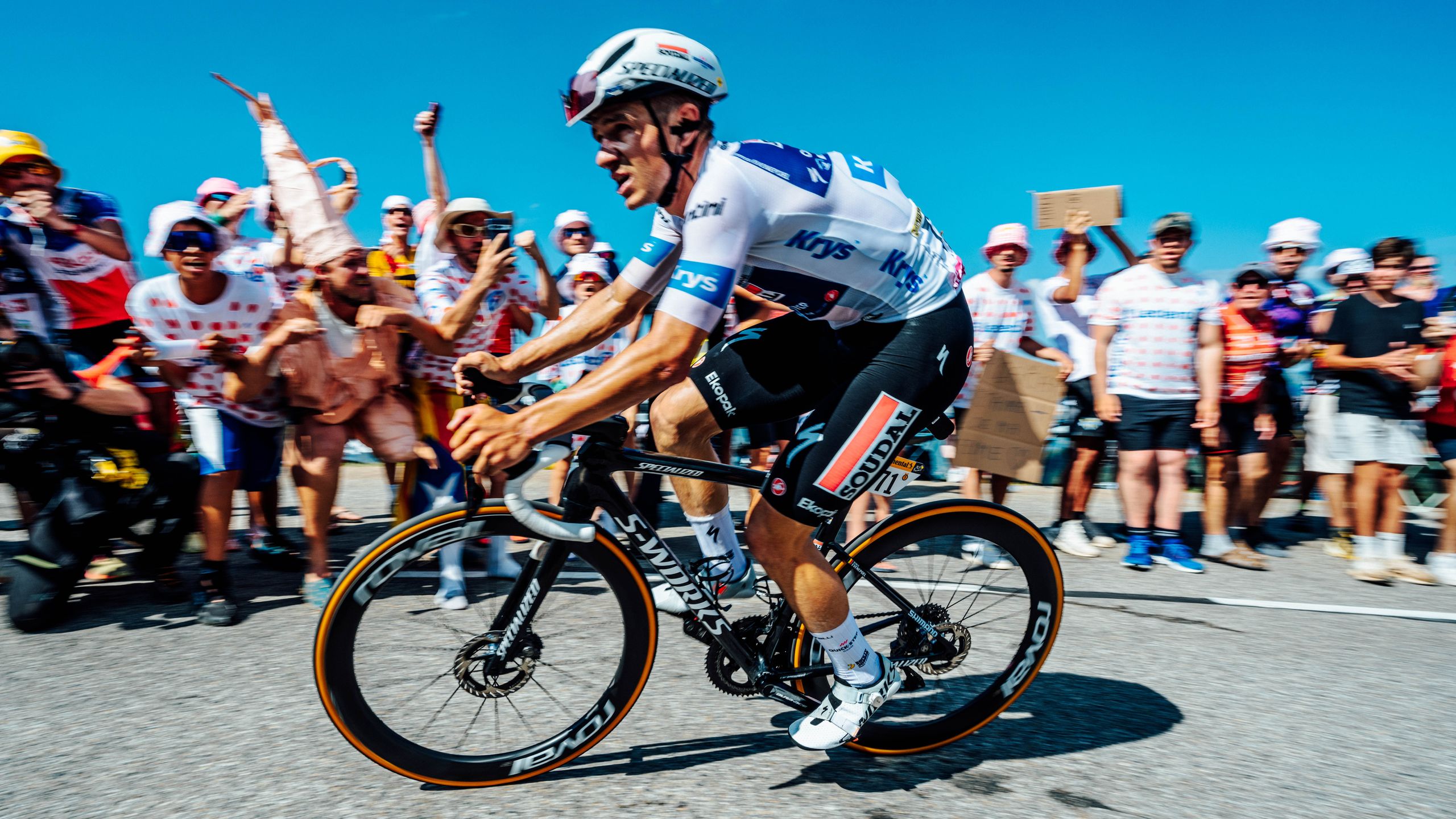
 www.cyclingnews.com
It's not riders that have 700-1000+watt pulse are defining. .. pluse spurts don't do it consistently on climbs or during the crunch so what but they can.. Remco has it..Fat shame! Utterly ridiculous. They are all trim. The point, as ever, is weight to power ratio. Who at the best weight can carry it through with devastation matters. Body type comes into play, inevitabily, then, talent, crashes, mechanicals, race noos determines. Ad astra.

His old ones were too fat. Made of hamburgers and fries.Specialized releases superlight, super expensive S-Works shoes, designed for Remco Evenepoel to wear at the Tour de France
The S-Works Torch Remco shoes are the brand's lightest and most expensive yet
Remco shoes lost weight.
All info we have about his weight during the '22 Vuelta and '24 TDF (his best climbing performances) points to him weighing around 62kg or slightly below that, during those GT's. That is roughly 4kg more than Vingegaard (who is even slightly taller) when he won both his TDF's. For arguments sake, let's assume Evenepoel would be able to lose 4kgs without losing power (i doubt he can and will, but just as a reference) he would then climb 2 minutes faster per 30 minutes compared to last year. That's how insignificant the weight difference is.But OK a number of 2 kilos was thrown around. I assume that not 2 kilos of fat as i doubt it's fat that wins Remco TTs. Anyway around 60 kilo then, fine. Lets see if Remco ever starts a GT at around 60 kilos and on how the numbers and results will look like.
His old ones were too fat. Made of hamburgers and fries.
All info we have about his weight during the '22 Vuelta and '24 TDF (his best climbing performances) points to him weighing around 62kg or slightly below that, during those GT's. That is roughly 4kg more than Vingegaard (who is even slightly taller) when he won both his TDF's. For arguments sake, let's assume Evenepoel would be able to lose 4kgs without losing power (i doubt he can and will, but just as a reference) he would then climb 2 minutes faster per 30 minutes compared to last year. That's how insignificant the weight difference is.
During the '21 Giro, he weighed around 60kg. But since he faded away during the second part of that Giro, the team has always assumed that was because he was too skinny, and never took into account the fact that it was just too soon after his injury and his preparation had been cut far too short. I don't know whether he would perform optimally (or more optimal) at 60kg compared to 62, but at least it did show that he is capable of dropping so low in weight, without getting sick.
Opening TT showed he was not where he needed to be. I agree with your points, but he was also clearly fading in week 2.wasn't even that it was too soon. He failed in the 2021 giro because he WASTED so much energy getting dropped due to his absolutely sucktacular bike handling. Getting dropped on the DOWNHILL of the first climb of Zoncolon, needing to chase for 45 minutes...
That was pathetic!
Don't get me started about his positioning and bike handling on the gravel stage

You don't see a difference between a rider like Vingegaard being 1m75 and 58kg, and someone like Evenepoel at 1m71 and 64kg. Since you don't think he needs to lose more weight, his normal weight is 64-65kg during the season when not preparing for a GT. That's 12% more weight he has to carry up a mountain compared to Vingegaard.I mean the most basic one is calculating BMI and even here i don't see it.
We really don't know racers' weigh though, right?You don't see a difference between a rider like Vingegaard being 1m75 and 58kg, and someone like Evenepoel at 1m71 and 64kg. Since you don't think he needs to lose more weight, his normal weight is 64-65kg during the season when not preparing for a GT. That's 12% more weight he has to carry up a mountain compared to Vingegaard.
No, I said 64-65kg, because according to CyclistAbi, the amount didn't really matter as much. That's why I said during the season, Evenepoel is at 64-65kg, it's only for a GT like Vuelta or TDF he drops to 61.5-62kg.We really don't know racers' weigh though, right?
58 kg is (rumored) for JV, but RE is (rumored) 62 kg, so that changes your math (7%). Using your line of thinking, can RE produce 7% more watts? Can he get to 60 kg (3.5%)? Can he produce 3.5% more watts?
Circling back to my main assertion: RE needs to live closer to his GT weight. He needs to be racing in March within 3-4% of his GT weight (and not after a starvation diet in February).
TP is (rumored) 64.5 kg at the TdF and 67 kg at Flanders for comparison.
Opening TT showed he was not where he needed to be. I agree with your points, but he was also clearly fading in week 2.

Looks like that's 7:30 Pacific, and it's available on Sporza.Remco starts at 16.30 tomorrow. Unfortunately i'll probably won't get to to see it live.
Nothing compared to what he has to carry himself or so I have heard.Have we calculated the weight of expectations he faces from the Belgian press?


 Facebook
 Twitter
 Instagram