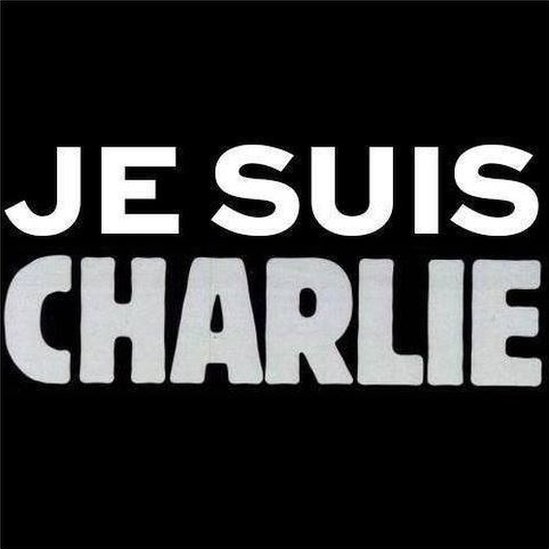
De tout coeur avec Charlie Hebdo. The Hammock: by Michele Serra
I would have wanted to leave this cubical of ink space empty today, as a sign of mourning and disconsolate impotence; but then I thought that terrorism has an invincible enemy, and this enemy is the normalcy of our daily lives. That is the habits, the useful and useless gestures, the banal tasks, work, reading, writing, the exchange of words: in short the dense and super powerful social plot we weave that the terrorist intends to lacerate. Its objective is to render us different than we are: either more afraid, or meaner, or more disoriented. If, to the contrary, we are able to—in the case of terrorism—remain unchanged, well then we cannot but be victorious, like an enormous and pacific river that submerges each malevolent asperity. My job is to write every day and I want to and must do so. We imagine—like what happened at London after the Islamic carnage in the subway—the confusion, the dismay, a brief flash of panic, and then the city restarted chewing its day. Each one of us—not only the satirical cartoonists—is a potential target of a bomb or shooting. However, we are so, so many and so, so alive and so, so busy, that to stop us is impossible. It’s like stopping time that ineluctably passes by.
In the pencil massacre young fanatics slaughter old libertines, by Michele Serra
It’s not true that for Charlie Hebdo nothing is sacred. Sacred, in that old Parisian news magazine, is liberty. Liberty danced, naked and happy like Wolinsky’s ladies, around the fragile journalistic trenches of desks covered with paper, pens and pencils, dailies, black magic markers (the arsenal of the victims) upon which the unrepentant French satire artists, most of whom were old, have fallen: old libertines murdered in cold blood by their bigoted young assassins. Seasoned veterans like Georges Wolinsky, Charb, Cabu, who were unscathed after numerous court hearings for obscenity, who had evaded being censored time and time again and experienced failures, had even survived many bitter quarrels within the most adversarial world of satirical journalism; to then die thusly, slaughtered by two blood thirsty and craven imbeciles who of liberty they can’t and don’t want to know anything about. Liberty is to fanatics what fish are to dry. land.
The stock of Charlie Hebdo and of its precursor, Hara Kiri, is that of the rational secularism and fervent laicism, which is so deep rooted in France, of the République: with a strong constitution of sexual freedom, anarchic and anticlerical imprint that blossomed, though was already present back in the Belle époque and dada eras, with the 1968 generation of social revolution. The undisputed inspirer of the magazine was Francois Cavanna (of Piacenza origins), an old-timer, rebellious hippy author of hilarious and merciless lines about all the people who fall into the clutches of power and religion, which demand no less than total submission. Cavanna died in his bed about a year ago, ninety years-old, pail and thin like a guru, spared from this horror and the agony of knowing about the macabre offense, so deeply inflicted, his jolly tribe has had to sustain.
The trademark of that satirical milieu, unaltered over the last decades despite being the target of numerous warheads, is a sort of sacrosanct freedom of expression extremism, which even irritated the self-righteous and decency-minded left and was always loathed by the traditionalist right. The gay chief editor of the news magazine, Philippe Val, just a few years ago, following a television debate was followed and beaten-up by a group of homophobic Christians who wanted to teach him the correct way of existing in the world. It was a humiliating vendetta, though nothing before the monstrous outcome of the new conflict in which Charlie Hebdo, let’s say by its very nature, could not have not gotten itself embroiled in the thick of the battle: that between liberty of expression and Islamic fundamentalism. It is a long war that “officially” began in 1989 with the fatwa against Salman Rushdie and his Satanic Verses. It is a domestic war within Europe; let’s not forget that, from its very first act. For it appears that the death sentence placed on Rushdie was inspired by the London radical Islam matrix, as if the stubbornness of that part of Islam against the freedom of expression were sharpened, irreparably, by the promiscuity with our customary ways, including our (sacrosanct) shameless rudeness.
Satire, by its very nature, is a language of boundaries; is extreme in its discipline and is not concerned with making people feel comfortable. Remaining (and unfortunately we are obliged to do so) within the bellicose metaphor, it is like a platoon of party-poopers, who inevitably break up the ranks, disrupt the established order and destabilize the roles. It would be totally immoral to, here and now, reopen the debate about blasphemy, or if you like insolence before the religious dogmas. It would be the most blasphemous thing to do before those innocents killed, who certainly died for liberty (in the name of liberty and for the cause of liberty). It would be as if from backstage, and with our asses safe and sound, we idiotically were to permit ourselves the right to evaluate the risk these fallen had placed upon themselves for defending all of our freedom to independent thought and expression.
Let us thus limit ourselves to certify that, on the battlefield of freedom of speech and liberty of expression, satire cannot but be at the front line, and that Charlie Hebdo decided not to take one step backwards. This while knowing all too well—let’s not forget that—that even just being a news magazine substantially comprised of a few jolly-minded, mostly senior hippy cartoon illustrators, a collision with the Islamic iconoclasts was inevitably part of the game at stake. The victims of this massacre all wielded, metaphorically, or in reality, their drawing pencil in hand. The pencil, in this veritable Ground Zero of freedom of the press, was the minimal, yet supper imposing, skyscraper that was knocked down. Put a pencil in your pocket over the next few days to feel yourselves closer to Charlie Hebdo, even if you never read it, even if you don’t like satire very much and you find it excessive, upsetting and provocative.
Let us thus salute them with an open smile—they wouldn’t want anything better—those passionate guys, just as intelligent as they were harmless: the chief editor Charb (Stéphane Charbonnier), Cabu (Jean Cabus), Tignous (Berdard Verlac), Georges Wolinsky, ravaged by the black hole of political-religious hatred, along with the journalist, Bernard Maris, in addition to five other colleagues and two policemen. Try to imagine, to get a grasp on the import of the massacre of Rue Nicolas-Appert, if the cartoonists each day who in the satirical vein make you reflect upon things, or laugh over the stupid follies of humanity in your own news sources, were to be slaughtered by a pogrom of fanatics, creating an emptiness on those so whimsical, but oh so indispensable, pages. Let us never forget, not even for a second, the perfumed scent of liberty, and how much we are indebted, as Europeans, to France and Paris





















 Facebook
 Twitter
 Instagram